Call for applications: Writing Competitive Scientific Proposals for Funding
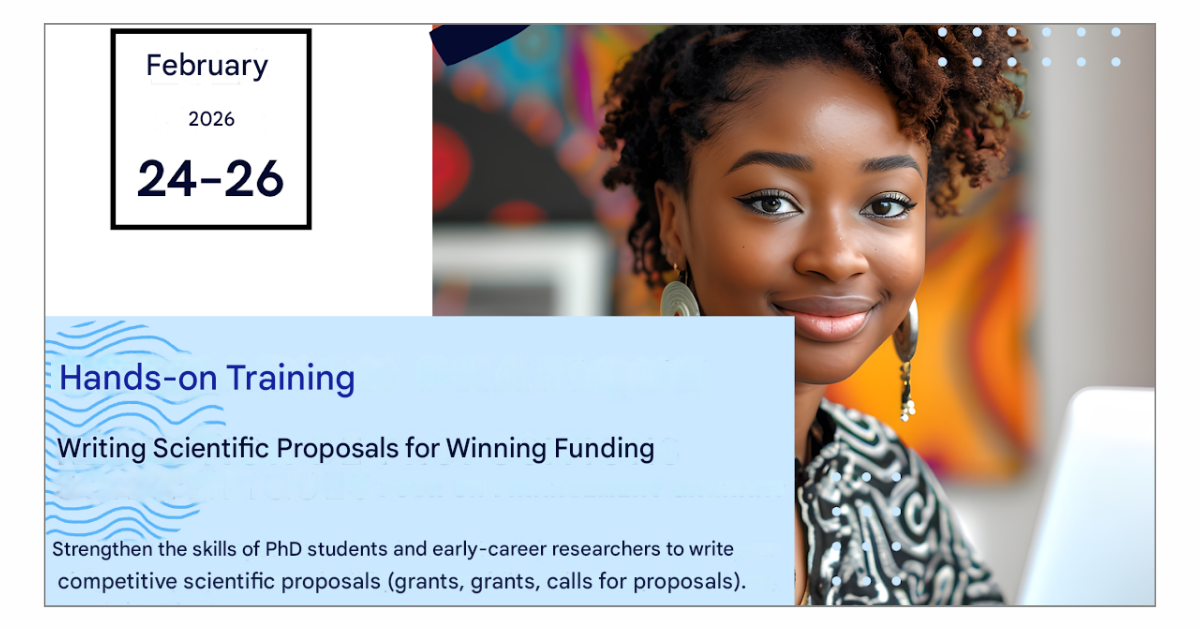
~ Free training programme for early-career~
Hybrid format (in person and online)
Please note that the training will be only in French
Dates: February 24-26, 2026
Location: Abomey-Calavi Campus, Benin
Context and justification
As part of its efforts to strengthen research capacity and promote academic excellence, the National Water Institute (INE) of the University of Abomey-Calavi, Benin (UAC), in partnership with its collaborators in Benin, is launching a call for applications for an intensive training program on scientific proposal writing aimed at securing research funding (scholarships, national and international grants, competitive calls for proposals, etc.).
This training seeks to equip Beninese researchers—particularly doctoral candidates, postdoctoral fellows, and early-career faculty members—with the methodological, writing, and strategic skills essential for the design, structuring, and submission of strong and compelling research proposals that align with funders’ expectations.
Indeed, writing rigorous and attractive scientific proposals is crucial for capturing the attention of funding bodies, whether international organizations, government agencies, research institutions, or private foundations. A high-quality proposal must not only demonstrate the scientific relevance of the project but also its feasibility, potential impact, and alignment with funders’ priorities. However, many early-career researchers face difficulties in developing proposals that meet the requirements of evaluation committees. They often lack clear guidance on how to structure their projects effectively, formulate a relevant research problem, define clear objectives, and present a coherent, methodical, and realistic research plan. Recurrent challenges are also observed in the preparation of viable budgets and realistic, sustainable timelines.
This training therefore aims to support doctoral candidates, early-career researchers, and project leaders in acquiring the essential skills needed to write effective, targeted, and competitive scientific proposals. By providing structured guidance and strengthening participants’ writing and strategic capacities, the program seeks to significantly increase their chances of success in mobilizing research funding. As such, it represents a valuable opportunity for young researchers—often new to this exercise—to take a decisive step toward the realization of their scientific projects and the advancement of their academic careers.
Institutional and financial support
This training program benefits from the financial, technical and institutional support of several national and international organizations committed to promoting research, development of scientific skills and leadership. This includes:
The National Water Institute (INE), Africa's Center of Excellence for Water and Sanitation (C2EA), host of the event;
The Alexander von Humboldt Foundation (AvH), for its continued support of research and to scientific mobility;
The Technology Transfer Office (BTT) of the National Water Institute (INE), for its support of innovative projects that generate business ideas;
The Distance Learning Centre (CED) of the National Water Institute (INE), for its support in establishing an institutional framework dedicated to the provision online courses, in order to strengthen access to education across Africa.
The Polytechnic School of Abomey-Calavi (EPAC), for its support in contributing to the development and revision of strategic documents, particularly through its support in finalizing the call for proposals;
The Alexander von Humboldt Foundation Alumni Association in Benin, for his commitment to capacity building for young researchers;
The WaSahelNet network, for its support of research in hydrology, water and environment in Sub-Saharan Africa;
The Association of Women Scientists of Benin (AFSB), for its support of equity of gender in science;
The International Association for Hydro-Environment Engineering and Research (IAHR), for its support in promoting scientific excellence in the field of water and the environment.
Objective of the call for training
The main objective of this training is to equip participants with best practices and effective strategies for writing competitive scientific proposals that are likely to lead to funding. More specifically, by the end of the training, participants will be able to:
✓ Understand the logic of calls for proposals as well as the criteria used to evaluate submissions;
✓ Identify and analyze relevant funding opportunities at the national, regional, and international levels;
✓ Develop an attractive academic curriculum vitae and a clear, compelling motivation letter;
✓ Structure a complete and coherent scientific proposal, including the abstract, problem statement, literature review, objectives, methodology, work plan, budget, expected impacts, and risk management;
✓ Master good writing and argumentation practices, particularly clarity, conciseness, interdisciplinarity, integration of the gender dimension, ethics, and innovation;
✓ Highlight the impact of research projects by emphasizing their scientific, economic, social, and/or environmental outcomes.
Desired profile and main responsibilities
This course is primarily aimed at students enrolled in the second year of a Master's program, doctoral students enrolled in a Beninese institution (in-person), or in an institution of West Africa (distance learning), as well as young PhDs (no more than five years after the defense).
Applications from women are strongly encouraged.
Advantages
The cost of the training and meals will be fully covered by the organizers. Upon completion of the training:
A certificate of participation will be given to each participant;
Post-training support will be provided (collective review, implementation) network with mentors);
Participants will have the opportunity to join a peer group for follow-up and support for their submissions.
Note: Travel expenses for in-person participation are entirely the responsibility of the Participant's responsibility. Meals during the three days of training are provided. by the organization for in-person participants.
Application File
The application file must be submitted exclusively via the online form provided for this effect. The following documents must be attached in a single PDF file, respecting the order indicated : Fill this form
A copy of the pre-registration form (for Master's and doctoral students)
A photocopy of the thesis diploma (for PhD holders)
Detailed CV (2 pages max)
A cover letter (maximum 1 page with normal margins and spacing, size 12) demonstrating their relevance to the training and intended use of the skills acquired.
A letter of recommendation from the laboratory manager
Note : The folder file (the PDF) must be named as follows: Last Name First Name(s) (Ex: Mr. CODJO Justin: his file must be named: CODJO_Justin).
Application Submission
The deadline for submitting applications is Friday, February 6, 2026. at 23:59 GMT+1 (Cotonou time).
Unfortunately, incomplete applications or those submitted after the deadline will not be considered. Applications will not be considered. Only those selected will be contacted.
Contact: atelierbenin2026@gmail.com
Related