The International Journal of River Basin Management, Volume 24, Issue 1, 2026 is now available!
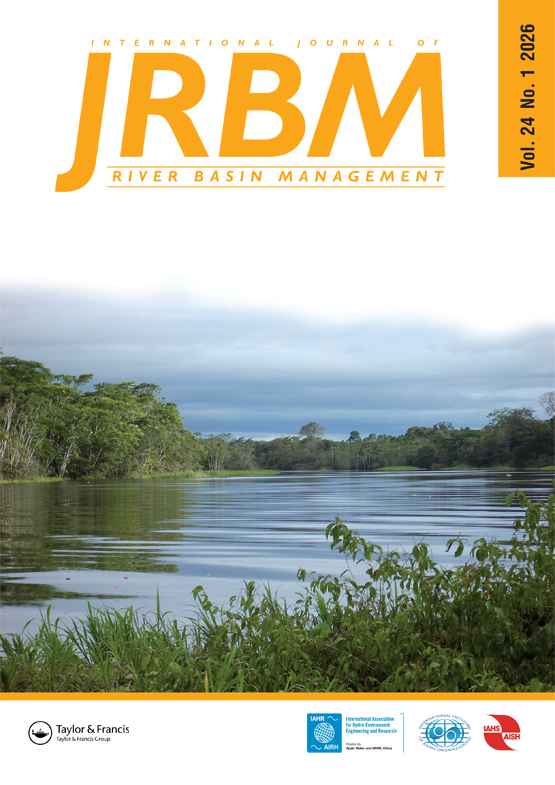 The Journal of River Basin Management (JRBM) plays a specific role in promoting a cross-sectorial approach encompassing all aspects of river and floodplain management, with a truly global perspective. The Journal is a response by the scientific and professional community to the World Water Vision and calls for an integrated approach to water resources management.
IAHR members can access the latest issue online for FREE through the IAHR website. Watch the tutorial.
Non IAHR members must access through Taylor and Francis website.
Overview
The new year of the International Journal of River Basin Management will bring some novelty, as we plan to increase the number of published issues to six, to better accommodate the increasing number of submissions we are receiving.
Regardless of such changes, JRBM will continue presenting high-quality articles covering a wide range of aspects connected to river basin management, spanning from the impact of extremes on river systems to water quality issues and socioeconomy, as clearly demonstrated by the works collected in Issue 1, Volume 24.
Readers are invited to look at all articles included in this issue, as they address typical challenges of freshwater systems, such as management of floods and droughts, but also transport of sediment or pollution due to heavy metals, utilising a wide range of methods, spanning from numerical modelling to multi-dimensional approaches. In this Issue, not only fluvial systems are considered, as some studies investigate groundwater contamination and land degradation, aspects that are central to river basin management.
The first issue of 2026 is a collection of very good papers, and a must-read for all scholars and professionals interested in deepening their knowledge of river basin management.
Articles
A physical-based semi-distributed continuous hydrological modelling for Brahmani River Basin, Eastern India
by Roshan Suryakant Mohanty and Sangeeta Kumari
Pages: 1-13 | DOI: 10.1080/15715124.2024.2366400Drought risk in the Mahanadi River basin: a multi-dimensional approach for integrated urban-rural drought management strategies
by Atul Kumar, Soumya Paramanik, Triambak Baghel, Malay Pramanik and Md. Mehedi Hasan
Pages: 15-33 | DOI: 10.1080/15715124.2024.2368176Current flood risk management: gaps and perspectives in Stung Sen Catchment, Cambodia
by Pinnara Ket, Voitna Prak, Ratboren Chan, Ty Sok, Layheang Song and others
Pages: 35-45 | DOI: 10.1080/15715124.2024.2372775Analyzing the impacts of watershed management interventions and scenarios on soil erosion reduction using InVEST model in Yezat watershed, North West Ethiopia
by Zemenu Awoke Andualem, Derege Tsegaye Meshesha and Ebrahim Esa Hassen
Pages: 47-64 | DOI: 10.1080/15715124.2024.2376077Linking environmental, social and economic sustainability. Case study: basin and reservoir of the Valle de Bravo Dam, Mexico
by Alfonso Guillermo Banderas and Rebeca González-Villela
Pages: 65-77 | DOI: 10.1080/15715124.2024.2376833Strategic flood risk management over time. Applying a temporal lens to see how flood risk management measures are (or are not) implemented

by Thomas Thaler, Gérard Hutter and Walter Seher
Pages: 79-87 | DOI: 10.1080/15715124.2024.2379886Estimation of suspended sediment load to the Volta Lake under changing climate using empirical discharge-sediment equations
by Emmanuel Obuobie, Mark Osei-Owusu, Geophrey Kwame Anornu, Collins Asante-Sasu and Ruby Asmah
Pages: 89-100 | DOI: 10.1080/15715124.2024.2382175Socioeconomic spatial analysis through fuzzy system as a tool for territorial planning applied to watersheds
by Leticia Tondato Arantes, Arthur Pereira dos Santos, Camille Vasconcelos Silva, Liliane Moreira Nery, Mayra Vannessa Lizcano Toledo and others
Pages: 101-117 | DOI: 10.1080/15715124.2024.2387579Hydraulic models of silled orifices and stilling basins in online dams for flood reduction
by Francesco Calomino, Antonino D’Ippolito, Agostino Lauria, Giancarlo Alfonsi and Roberto Gaudio
Pages: 119-131 | DOI: 10.1080/15715124.2024.2389197Distribution and ecological health risk assessment of heavy metals in damietta branch of Nile River, Egypt
by Said A. Shetaia, Mohamed S. Elhebiry, Mohamed El Ashry and Mohamed Mohsen
Pages: 133-144 | DOI: 10.1080/15715124.2024.2390562Assessment of groundwater susceptibility to contamination using GIS-based modified DRASTIC model in the Rib watershed, Upper Abay Basin, Ethiopia
by Ayalneh Yedem Fentie and Abebaw Andarge Gedefaw
Pages: 145-160 | DOI: 10.1080/15715124.2024.2391894Land degradation vulnerability mapping using geospatial techniques: a case study of Nandakini River basin, NW Himalaya, India
by Rohit Kumar, Jaspreet Kaur Khaira, Rayees Ahmed, Rahul Devrani and Benidhar Deshmukh
Pages: 161-176 | DOI: 10.1080/15715124.2024.2396141
Article Collections
Call for papers for a JRBM Article Collection on Water Management in Remote Regions and Transboundary Basins Guest Editors: Ramesh Teegavarapu, Elpida Kolokytha and Michael Nones (closed)
Call for Papers for a JRBM Special Collection on African Water Security in the International Journal of River Basin Management Guest Editor: Moez Louati (closed)
Call for papers for JRBM Article Collection on From data to decision: stakeholder-driven approaches for a resilient water future Guest Editors: Pedro Martínez-Santos, Albretch Weerts, Harm Duel, Helmut Habersack, Michiel Blind, Leandro Ávila, Maggie Kossida, Virginie Keller and Julie Collignan. Deadline 31 January 2026
