Call for proposals to host the 18th International Conference on Urban Drainage (ICUD) in 2030
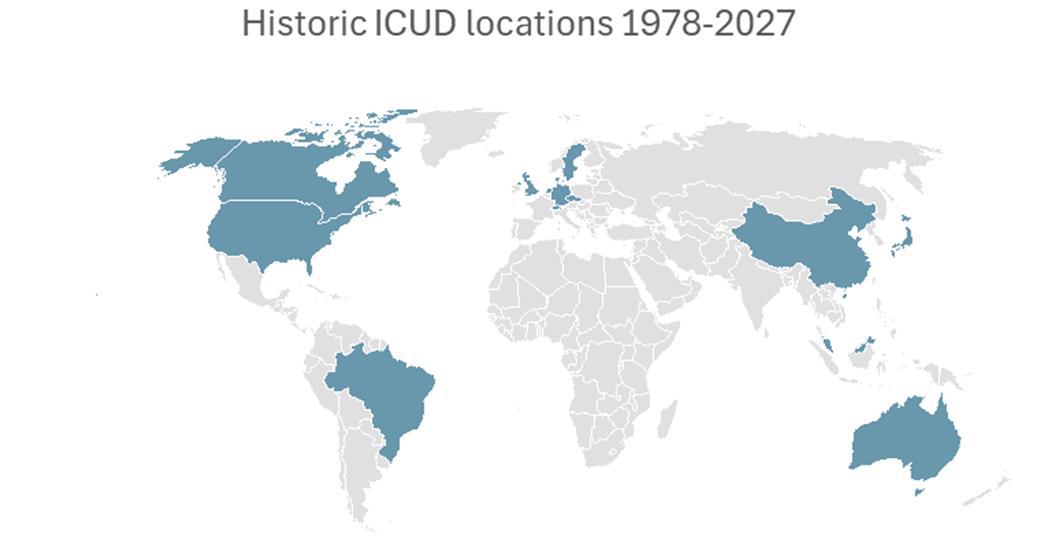
The Joint Committee on Urban Drainage (JCUD) of IAHR and IWA is inviting the interested parties to submit proposals to host the 18th International Conference on Urban Drainage (ICUD) in 2030. This conference will build on success of the previous conferences in this series, which were held in Southampton (UK, 1978), Urbana-Champaign (USA, 1981), Gothenburg (Sweden, 1984), Lausanne (Switzerland, 1987), Osaka (Japan, 1990), Niagara Falls (Canada, 1993), Hannover (Germany, 1996), Sydney (Australia, 1999), Portland (USA, 2002), Copenhagen (Denmark, 2005), Edinburgh (UK, 2008), Porto Alegre (Brazil, 2011), Kuching (Sarawak, Malaysia, 2014), Prague (Czech Republic, 2017), Melbourne (Australia, 2021) and Delft (Netherlands, 2024). The 17th edition will be held in Ningbo, China, in 2027.
The ICUD conference aims to present the latest advances and innovative approaches in fundamental and applied research on urban drainage, considering meteorological, hydrological, hydraulic, water quality and socio-economic aspects worldwide. The ICUD strives to maintain its long-standing broad international recognition as a prominent platform for the advancement of scientific knowledge in the field of urban drainage. It considers its activities in the wider context of urban water systems, with the ambition of developing and promoting a sustainable and integrated urban water management.
We will take a two-stage approach to submitting applications to host the 18th ICUD in 2030. From the Stage 1 submissions, a maximum of four will be invited to submit a full proposal.
Stage 1 proposal deadline: 16th of March 2026.
Stage 1 outcome information by April 10th, 2026.
Stage 2 proposal deadline: 8th June 2026
Stage 2 outcome during Novatech conference in France, early July 2026
All proposals must be in English and submitted electronically in PDF format to the JCUD Event’s coordinator Job van der Werf (j.a.vanderwerf@tudelft.nl), with the JCUD secretary Alma Schellart copied in (a.schellart@sheffield.ac.uk).
Page limit stage 1 proposals is 1 page of A4; page limit stage 2 proposals is 20 pages of A4. Proposals should use font size 12 and files should not exceed 7MB. If you require any clarification of the proposal specifications, please contact Job van der Werf, cc’ing Alma Schellart.
STAGE 1 Template – Maximum single page A4, font size 12, deadline 16th March 2026
Proponent team. Include names, contact email, affiliation and a brief motivation for their interest in organising their conference
Conference themes
Location and brief description of the venue
Indicative dates and duration
Proposed conference format, with indicative number of parallel sessions, keynotes and poster options.
Downlod the Stage 1 template here
STAGE 2 Template – Maximum 20 pages A4, font size 12, deadline 8th June 2026
Please make sure your Stage 2 proposal contains the following headers:
1. Conference title (sub-themes), location, dates and duration
Dates can be indicative. The code of practice is to organize ICUD conference from the very end of August until the mid of September. It should be guaranteed that the selected conference venue is available and pre-booked for proposed dates.
2. Proponent team
The proponent team should preferably consist of wider urban drainage community within the country/region, including relevant universities, research institutes and/or other stakeholders. Specify the conference chair and co-chairs including their affiliations and short description of their professional profile.
It should be clearly stated which organization is the main conference guarantor ultimately responsible for the event, including financing issues. The JCUD also expects a description of how the team plans to communicate with the JCUD, including the reporting during the preparation phase.
3. Motivation of the proponent team to organize ICUD conference.
Clearly describe the motivation and the capability of the proponent team to organize the high quality event.
4. Conference organization and management (Local Organization Committee, Program committee, International scientific committee).
The description of both the technical organization and scientific program management. The final list of committee members is not necessarily expected at this stage. The proponent team should describe the management structure, the responsibilities, the procedure of selection and nomination into the committees. The scientific committee’s structure should take into the account the range of conference topics and also geographical, gender and age distribution of the members.
5. Proposed conference program and format
The specification of preliminary conference program including the list/number of keynote lectures, parallel sessions, special sessions, workshops, technical exhibition, technical tours. The proponents are asked to specify the duration of the event, to specify the presentation formats including the format of poster sessions. It is also welcome to provide novel ideas and formats within the conference program
6. Poul Harremoës Award competition and Mid-Career and Career Achievement Awards
All the awards must be organized in close cooperation with the JCUD. The proponent must provide to the awards the publicity and the relevant time slots within the conference program. The proponent must also cover the cost for participation (conference fee, accommodation, travel) of the Poul Harremoës Award winner from previous ICUD2027 and should provide free registration to three PHA finalist in 2030.
7. Selection of contributions (abstract/paper review) and publishing of papers/proceedings
Describe the submission procedure and evaluation phase, including the preliminary dates. It should be also presented in which form the conference proceedings will be published (including the copyrights) and if the organizers will plan/offer the post conference publishing of selected papers in peer-review journals.
To encourage worldwide attendance, it is important to create both a permanent repository of conference proceedings, as well as allow flexibility of copyright for people who would like to publish elsewhere.
8. Conference venue (meeting rooms)
The ICUD conference usually attracts 500-700+ participants. This should be taken into account when choosing the appropriate conference venue with one plenary hall and other 5-6 meeting rooms for parallel sessions.
9. Accommodation (with approximate 2026 pricing)
Provide a list of accommodation capacities in the vicinity of the venue, in a wide range of price levels. Ensure there are sufficient low budget accommodation options.
10. Financial issues (budget, registration fees – discounts for IAHR and IWA members, potential sponsors or supporting authorities – documented by letters of support, if and where applicable)
The preliminary budget should provide the insight into expected incomes (fees, sponsors, local authorities) and realistic outcomes structured into the main categories such as venue rentals, catering, social program, labour costs etc.
11. Social program and post-conference tours
Show why to come to your location and country. Describe key transport links between the venue, accommodations and nearest local and international transport hubs. Describe how you plan to encourage Young Water Professionals activities during the conference
12. Any other points you may consider important.
Related
IAHR/IWA Joint Committee on Urban Drainage