Highlights from the IAHR Water Monograph Webinar: Application of the Lattice-Boltzmann Method in Hydraulics
Watch on Demand Water Monograph Series Download Water Monograph
About the Webinar
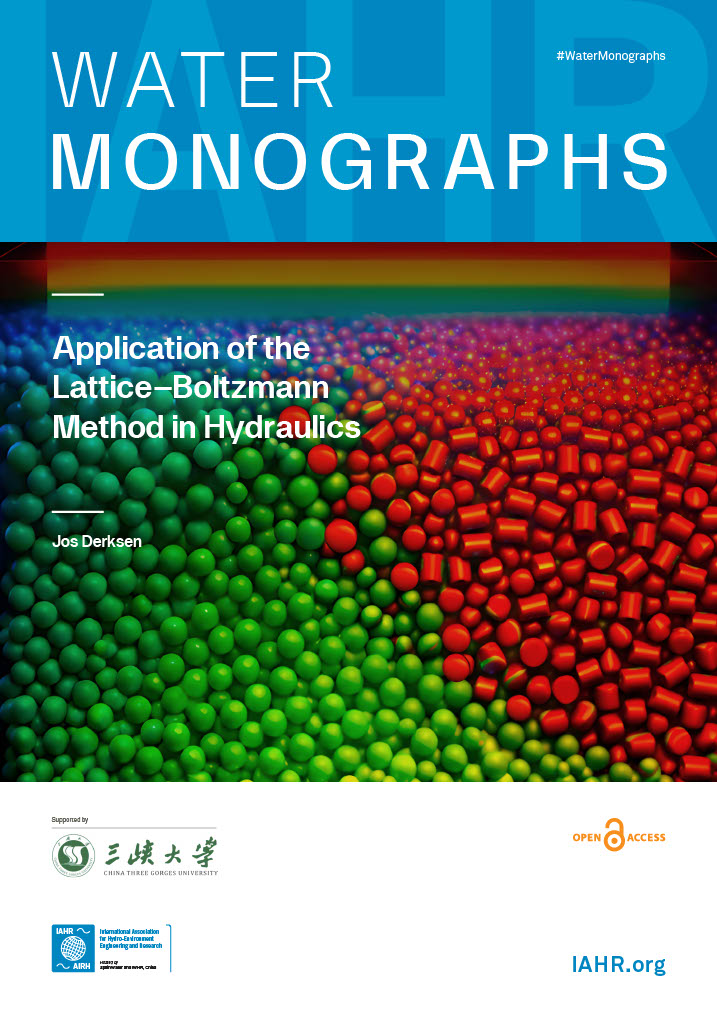
On June 2 2026, the IAHR hosted a webinar featuring Professor Jos Derksen of the University of Aberdeen, who presented the latest Water Monograph on the Application of the Lattice-Boltzmann Method in Hydraulics and Damien Violeau, from Electricité de France R&D (EDF) as a moderator. Professor Derksen presented the principles and potential of the Lattice-Boltzmann Method, illustrating its application to hydraulic problems including sediment transport, flexible vegetation dynamics and turbulent flow.
The webinar attracted a truly global audience, with registrants from over 60 countries across all major world regions and more than 300 registrations!
The majority of participants were from Asia and Pacific (31.8%), followed by Europe (28.2%), Latin America (14.9%) and Africa (14.6%)
India led registrations (4.9%), followed closely by the USA (3.3%) and the UK (3.3%)
Webinar Highlights
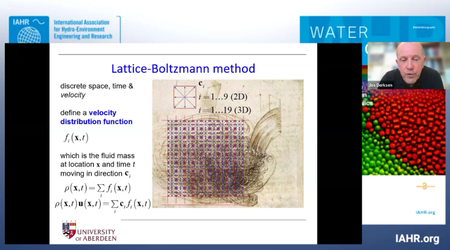
Introduction to the Lattice-Boltzmann Method: Professor Derksen provided an in-depth explanation of the Lattice-Boltzmann Method (LBM), a computational approach that discretises fluid flow into lattice points with discrete velocities and collision operators. Unlike traditional CFD methods based on Navier-Stokes equations, LBM evolves distribution functions representing mass moving in specific directions, ultimately converging to solve fluid dynamics equations with remarkable elegance and computational efficiency.
Key Applications in Hydraulics:
Sediment Transport Simulations – Particle-resolved simulations demonstrated how LBM can model granular bed mobility under varying Shields numbers, providing insights into sediment transport thresholds critical for hydraulic engineering.
Monami and Flexible Vegetation Dynamics – Simulations of soft hair beds revealed flow-induced waving behavior in submerged vegetation, with excellent agreement between numerical results and experimental validation.
Turbulent Flow with Suspended Particles – The method successfully captured complex fluid-structure interactions in both laminar and turbulent conditions.
Advantages and Limitations
Strengths of LBM:
Local and near-local operations enable efficient GPU computing with linear scaling
Excellent for transient, unsteady phenomena with high time resolution
Uniform grid spacing requirements make it ideal for systems with consistent resolution needs
Considerations:
Small Courant number requirements mean extended computation times for steady-state problems
Local grid refinement is not straightforward in simpler implementations
Multi-phase flows with large density ratios (such as air-water systems) remain challenging
Applications Beyond Hydraulics
The method extends far beyond water engineering, with applicability to any Newtonian or even non-Newtonian fluid systems under laminar or turbulent conditions. Potential medical applications in blood vessel dynamics and lung modeling were also highlighted.
Open Access IAHR Water Monograph Series
#WaterMonographs
The Open Access IAHR Water Monograph Series presents information on physical processes, measurement techniques, theoretical material, numerical modeling techniques, engineering applications, and historical and cultural matters in an appealing, readable, and well-illustrated manner.
More about IAHR Water Monograph Series
Certificates of attendance from this webinar will be issued upon request. Please contact iahr@iahr.org