The International Journal of River Basin Management, Volume 24, Issue 6, 2026 is Now Available!
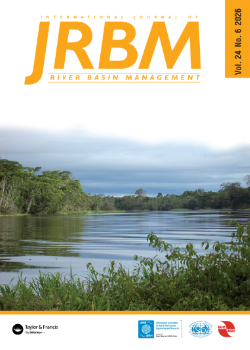 The Journal of River Basin Management (JRBM) plays a specific role in promoting a cross-sectorial approach encompassing all aspects of river and floodplain management, with a truly global perspective. The Journal is a response by the scientific and professional community to the World Water Vision and calls for an integrated approach to water resources management.
IAHR members can access the latest issue online for FREE through the IAHR website. Watch the tutorial.
Non IAHR members must access through Taylor and Francis website.
Overview
The Issue 6, Volume 24 of the International Journal of River Basin Management has just been published, and contains studies spanning water quality and estuarine processes, flood and drought management, hydrological and climate modelling, soil and water conservation, river governance, and fluvial geomorphology.
Among the sixteen papers constituting this issue, you will find water quality studies ranging from a real-time assessment and prediction framework combining variable weight theory and remote sensing on the Barak River, India, to the remote sensing of turbidity in Lake Tana, Ethiopia, the evaluation of two decades of water quality indices in the Lower Mara River, Tanzania, and the spatio-temporal variation of water quality in the Ashtamudi estuary, a Ramsar wetland in south-west India, where floc characteristics under the influence of Fe(II) are also investigated. Flood and drought issues are addressed through a review of urban flood resilience with adaptive community approaches, a case study of transboundary flood and drought challenges on the Sutlej River, Pakistan, the forecasting of the reconnaissance drought index in the Aras Basin, Turkey, using an ABC-optimised ANN integrated with VMD and REMD, and an assessment of the efficacy of woody debris dams in slowing and reducing peak discharge. Other contributions examine the impacts of climate change and variability on water resources management in the Kagera River Basin, Tanzania, the numerical modelling of navigable waterways with a discontinuous Galerkin method for the Meuse River – Campine canal flow, and the kinetic modelling of the attachment and detachment of pathogenic bacteria at a riverbank filtration site. The social and institutional dimensions of river basin management are explored through an analysis of emerging actors, competing interests and development claims in the Eastern Nile Basin. The issue closes with contributions on land and fluvial morphology, including soil and water conservation through sub-watershed prioritisation in the Dhansiri River Basin, India, the fractal and morphometric characterisation of drainage and fault systems in the tectonically active Mereg Basin, Iran, and semi-automated pixel- and object-based extraction of gully features in the lower Chambal River Basin, India.
This sixth and last Issue of 2026 showcases the wide range of topics considered by JRBM, as river basin management calls for a holistic approach, combining expertise from technical and social sciences.
Articles
Using Variable Weight Theory and Remote Sensing Analysis for Real-time Water Quality Assessment and Prediction – a Case Study of Barak River, Assam, India
by Pritam Talukdar, Vihangraj V. Kulkarni & Bimlesh Kumar
Pages: 935-958 | DOI: 10.1080/15715124.2025.2509184Dead Ends and New Beginnings: Emerging Actors, Competing Interests, and Development Claims in the Eastern Nile Basin
by Awol Ali Mohammed
Pages: 959-978 | DOI: 10.1080/15715124.2025.2509843Soil and Water Conservation in Dhansiri River Basin using a Sub-Watershed Prioritization Tool Approach
by Imyanglula, Lochumi Kikon, Chitrasen Lairenjam & Prabhakar Sharma
Pages: 979-989 | DOI: 10.1080/15715124.2025.2509846Spatial and Temporal Analysis of Lake Tana’s Turbidity Using Remote Sensing Techniques, Upper Blue Nile Basin, Ethiopia
by Ahmed Hiyaru Yassin, Asmare Belay Nigussie, Asanke Enawgaw Amognehegn, Fasikaw A. Zimale, Moges Getahun Yalew & Shegaw Melak Akele
Pages: 991-1005 | DOI: 10.1080/15715124.2025.2509871Numerical Modelling of Navigable Waterways Using a Discontinuous Galerkin Method: study of Meuse River – Campine Canal Flow
by Amit Ravindra Patil, Fabricio Fiengo Perez, Jonathan Lambrechts, Insaf Draoui, Eric Deleersnijder & Benjamin Dewals
Pages: 1007-1030 | DOI: 10.1080/15715124.2025.2509889Urban Flood Resilience with Adaptive Community Approaches: a Review
by Maniyammai Kumaresen, Fang Yenn Teo, Anurita Selvarajoo, Subarna Sivapalan & Roger A. Falconer
Pages: 1031-1051 | DOI: 10.1080/15715124.2025.2511901Transboundary Flood and Drought Challenges: a Case Study of the Sutlej River in Pakistan
by Muhammad Rizwan Akram
Pages: 1053-1072 | DOI: 10.1080/15715124.2025.2512955Advanced Forecasting of the Reconnaissance Drought index in the Aras Basin, Turkey Using ABC-optimised ANN with VMD and REMD Integration
by Okan Mert Katipoğlu, Mohammed Achite, Nehal Elshaboury & Eslam Mohammed Abdelkader
Pages: 1073-1094 | DOI: 10.1080/15715124.2025.2512960Impacts of Climate Change and Variability on Water Resources Management in Kagera River Basin, Tanzania
by Estella Laurent Mgala, Joel Nobert & Edmund B. Mabhuye
Pages: 1095-1115 | DOI: 10.1080/15715124.2025.2513667Assessing the Floc Characteristics Under the Influence of Fe (II) in the Ashtamudi Estuary, India
by Febina A. Manaf & K. L. Priya
Pages: 1117-1139 | DOI: 10.1080/15715124.2025.2514660The Use of Water Quality Indices in Evaluating Water Quality Trends from 2003 to 2023 in the Lower Mara River, Tanzania
by Irene Calist Kimario, Msafiri Yusuph Mkonda & Silvia Francis Materu
Pages: 1141-1158 | DOI: 10.1080/15715124.2025.2515244Kinetic Modelling of Attachment and Detachment of Pathogenic Bacteria in Batch Culture System from Riverbank Filtration (RBF) Site
by Siti Baizura Mahat, Miskiah Fadzilah Ghazali, Ummi Kalsum Hasanah Mohd Nadzim, Charles Ng Wai Chun, Noor Fazliani Shoparwe, Muaz Mohd Zaini Makhtar & Husnul Azan Tajarudin
Pages: 1159-1175 | DOI: 10.1080/15715124.2025.2516138Fractal and Morphometric Characterization of Drainage and Fault Systems in the Tectonically Active Mereg Basin, Western Iran
by Hadi Nayyeri, Rozin Moradi & Hadi Sanikhani
Pages: 1177-1194 | DOI: 10.1080/15715124.2025.2517831Semi-automated Pixel and OBIA Based Approaches for Gully Feature Extraction in the Lower Chambal River Basin, Central India
by Rohit Kumar, Rahul Devrani, Manish Pandey, Benidhar Deshmukh & Romulus Costache
Pages: 1195-1217 | DOI: 10.1080/15715124.2025.2521098Modelling the Efficacy of Woody Debris Dams in Slowing and Reducing Peak Discharge

by David Furnues, Judith R. Cudden & Matthew McParland
Pages: 1219-1225 | DOI: 10.1080/15715124.2025.2505596Status of Spatio-temporal Variation in Water Quality of Ashtamudi Estuary: a Ramsar Wetland, Southwest India
by Roshni Mohan, C. S. Ratheesh Kumar, A. Sudha, P. V. Vidya & Radhakrishnan Amal
Pages: 1227-1242 | DOI: 10.1080/15715124.2025.2521484