The Dean Supporting Hunter Rouse
Sometimes a perceptive, forward-looking dean recruits and then supports a remarkable faculty member, especially if the member’s research and education activities bring fame to the dean’s college. The dean need not be technically outstanding but should be willing to support the outstanding faculty member. Francis M. Dawson (1888-1961; from Canada; UI Engineering Dean 1936-1959; and IIHR Director 1936-1944) typified this ideal as he hired and supported hydraulician Hunter Rouse (1906-1996; IIHR Director 1944-1966) and ultimately helped him bring fame to the Iowa Institute of Hydraulic Research (IIHR) and the University of Iowa’s College of Engineering (UI).
At first glance, Dawson seems an unlikely recruiter and supporter of Rouse. Though he had hydraulic engineering expertise, his own research as IIHR Director concentrated on everyday aspects of hydraulic engineering – aspects best described using the term “plumbing” –the design of toilets and pipes, water heaters, and grease removal from drains, all topics of pressing practical importance. Yet as dean, Dawson envisioned hydraulic engineering to be demonstrably explained and taught in terms of physics-based fluid mechanics. He saw in Rouse a potential faculty member who possessed the attributes needed to fulfill his vision. Additionally, Rouse had many of the traits of the leading professors Dawson had admired on his path to becoming dean: e.g., Dawson’s master’s-degree adviser at Cornell University, Ernest W. Schoder (whose 1903 paper with Augustus V. Saph was considered by Rouse to be one of the most outstanding papers in hydraulic engineering for the prior two centuries); and Dawson’s former colleague at the University of Wisconsin-Madison, Daniel W. Mead (whose books on hydrology, hydropower, and hydraulic machinery, were widely used).
The article in ASCE’s Journal of Hydraulic Engineering, “Francis M. Dawson, The Engineering Dean behind Hunter Rouse”, depicts salient aspects of Dawson’s life, as well as his career trajectory and association with Rouse. The article delves into the journal Nature’s harsh review of Dawson’s 1927 textbook, Hydraulics, coauthored with Schoder. That stinging review factored in the recruitment and support of Rouse, who too saw fluid mechanics as underpinning hydraulic engineering. Rouse dedicated his 1959 textbook, Advanced Mechanics of Fluids, to Dean Dawson.
Robert Ettema (IAHR member), Larry J. Weber (IAHR member and IIHR’s present Director), and Suzanne M. Kennedy (daughter of John F. Kennedy, IIHR Director [1966-1991] and IAHR President [1980-1983])
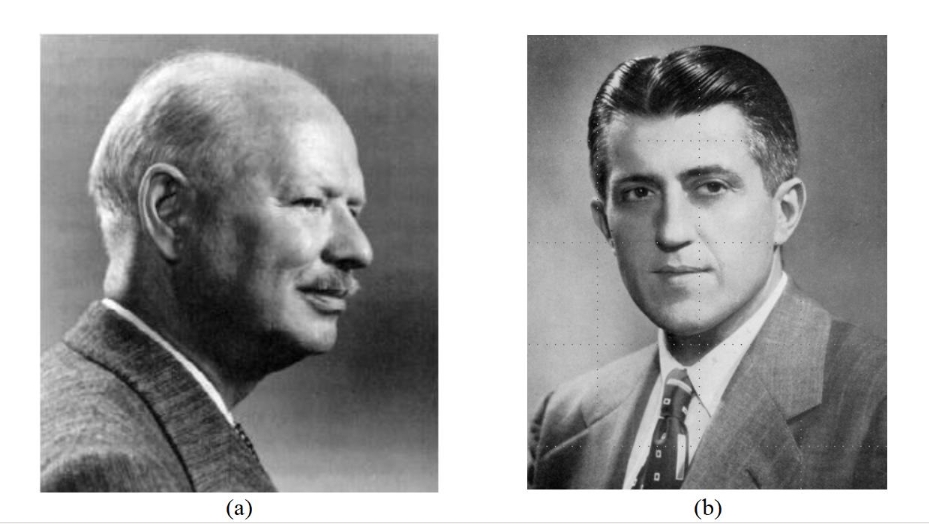
Dean Francis M. Dawson (a) and Professor Hunter Rouse (b) in about 1940
Related
IAHR Institute Member Iowa Institute of Hydraulic Research (IIHR)