Highlights from the IAHR Water Monograph Webinar on Guidance for Water Engineering in a Changing Climate
Recordings Water Monograph Series Download Water Monograph Presentations
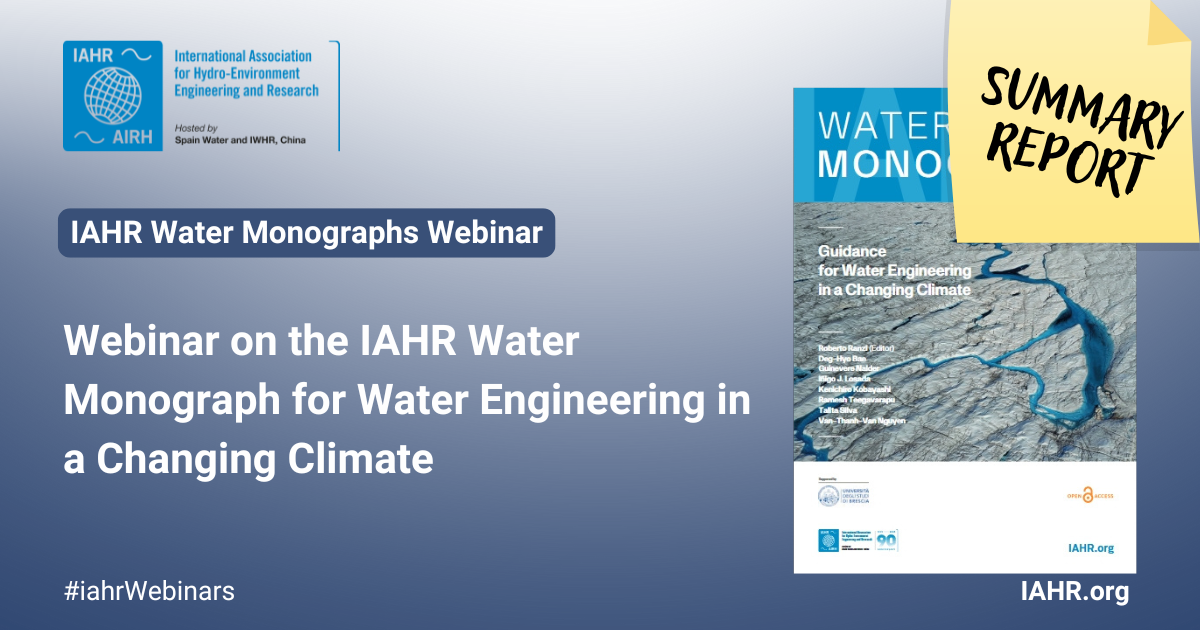
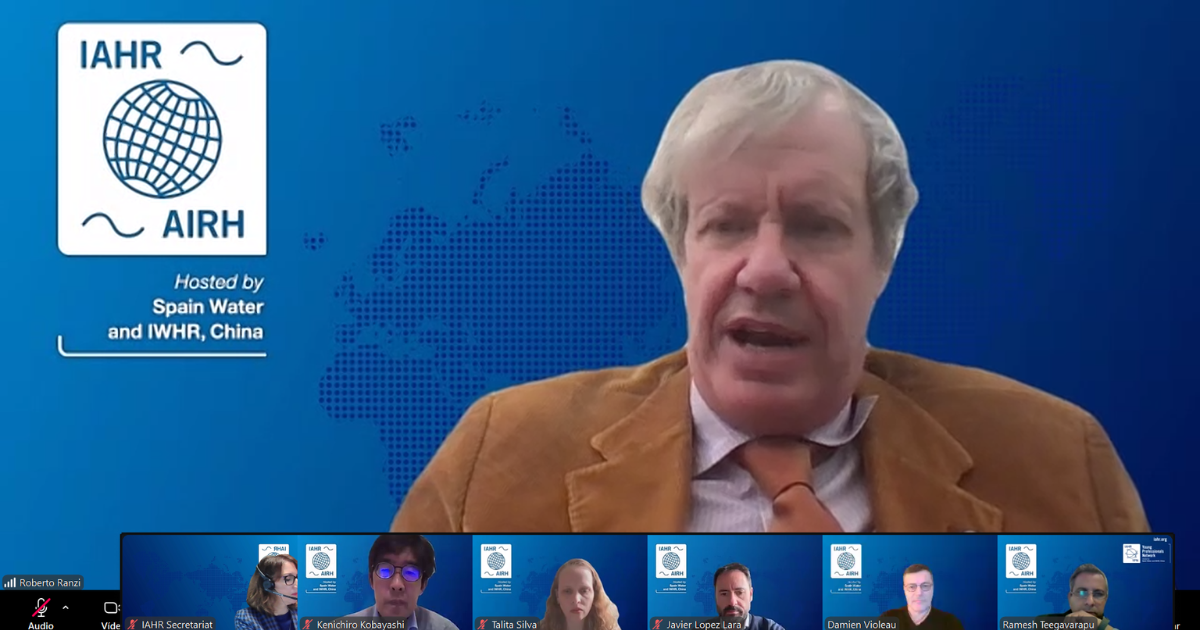
As part of the Series of the FREE IAHR Water Monograph Webinars, it took place on 17 December the one focused on the latest IAHR Water Monograph titled “Guidance for Water Engineering in a Changing Climate”. The webinar attracted strong interest from the international community, with 673 registered participants, reflecting the relevance and timeliness of the topic. The session was opened by Damien Violeau, Chair of the IAHR Task Force on Water Monographs, who explained the mission of the Open Access Water Monograph Series and acknowledged the support of the University of Brescia, which made possible the free download of this publication.
The webinar introduced the scope and structure of the monograph, edited by Roberto Ranzi, which provides comprehensive guidance for water engineering design and management under climate change. The monograph is organized into two main parts: climate change impact assessment and adaptation strategies, covering topics such as non-stationarity, hydroclimatic variability, climate projections, risk assessment, and sector-specific adaptation measures.
The IAHR Water Monograph “Guidance for Water Engineering in a Changing Climate” is freely available for download
Roberto Ranzi presented the overall framework of the monograph, highlighting recent findings from IPCC AR6 relevant to the water sector, including observed increases in heavy precipitation since the mid-20th century and complex regional patterns in flood behavior. He emphasized the need to move beyond stationary assumptions and adopt analytical tools capable of capturing climate variability, teleconnections, and non-linear trends, in order to support robust water engineering decisions.
Ramesh Teegavarapu discussed climate variability impacts and methods to address non-stationarity in hydrologic and hydraulic design. He highlighted the influence of large-scale climate oscillations on precipitation, floods, droughts, and sea level, and the need for revised design criteria, operational strategies, and adaptive planning in water infrastructure.
Talita Silva presented the role of Nature-Based Solutions (NbS) for climate change adaptation, highlighting their potential to reduce flood risk, enhance ecosystem services, and provide co-benefits such as improved water quality and biodiversity. Real-world examples demonstrated how NbS can complement or replace traditional grey infrastructure when designed within a holistic and participatory framework.
Javier L. Lara addressed adaptations of coastal defence systems under climate uncertainty. He emphasized the importance of risk-based approaches consistent with IPCC frameworks, accounting for non-stationary drivers, compound hazards, and local relative sea-level change. Adaptive pathways, monitoring, and staged decision-making were presented as key strategies to manage long-term uncertainty in coastal engineering.
Finally, Kenichiro Kobayashi focused on river and urban drainage management under climate change, using Japan as a case study. His presentation illustrated how large climate model ensembles and rainfall change multipliers are being incorporated into practical design and planning, despite scale mismatches between climate models and urban drainage systems. He stressed the importance of pragmatic approaches to bridge climate science and engineering practice.
Overall, the webinar demonstrated how the IAHR Water Monograph provides a coherent, state-of-the-art reference for researchers and practitioners, promoting risk-informed, flexible, and adaptive approaches to water engineering in a changing climate.
The IAHR Water Monograph Guidance for Water Engineering in a Changing Climate aims at providing a guidance to professionals, researchers and policy makers for assessing observed and projected impact of climate variability and change on the hydro-systems and to adapt the practice of engineering design of hydraulic infrastructures and water resources management to such changes. It will present an overview of methods for the analysis of non-stationary time series and of the estimate of the hydrological and hydraulic design variables as precipitation, floods, droughts, sea level and storm surges by relaxing the hypothesis of stationarity of the climate.

Related Content
IAHR Water Monograph Guidance for Water Engineering in a Changing Climate
Recordings. Watch on demand!