Hydrolink Magazine
HOME > Hydrolink Magazine

Advisory Board Latest issue (Free access) Upcoming issues Previous issues (Free access) Advertise in Hydrolink
#HydrolinkMagazine
Hydrolink is the primary magazine of the IAHR community and one of the highest-rated member benefits. It brings you the latest developments in the field of hydro-environment engineering and research through articles on projects, research, and new methods and tools of interest to the community. It also provides a platform for reporting on IAHR Conferences and news from our members, and offers a forum for exchanging information and spreading the word on topics and projects relevant to the community.
The online version of Hydrolink is open to non-members since 2021, as part of IAHR's efforts to disseminate and share knowledge. From 2027, all IAHR members will receive Hydrolink digitally by default, helping us reduce paper use and our environmental footprint. Members who wish to receive the printed edition can simply select this option when completing their membership renewal.
ISSN: 1388-3445
Publication Frequency: 4 issues per year.
Latest issue ↑
Hydrolink 3, 2026 | Research and Technical Innovation for Water Sustainability
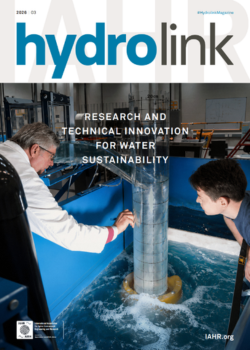
In hydraulic and hydrologic engineering, innovation is rooted in research. Scientific work improves understanding of water flows and their interactions with natural systems and built infrastructure; water-cycle dynamics, including floods, droughts, and other extremes; exchanges between surface water and groundwater; and water quality and chemistry. Innovation begins when this knowledge is translated into methods, technologies, and operating practices that can solve real-world water problems.
This issue of Hydrolink brings together examples of research and technical development that illustrate this broader view of innovation: the use of remote sensing for water-resource assessment, advances in ocean outfall design and operation, vortex-flow technologies for wastewater treatment and energy dissipation, and the emerging role of artificial intelligence, digital twins, and hydroinformatics in adaptive water management.
Download and share! Subscribe for free!
Contents
In depth > Remote Sensing
Innovation for Water Transformation by Philippe Gourbesville
Cognitive Water Sector: Redefining Water Infrastructure and Education in the Agentic Era by Ibrahim Demir and David Wegner
Monitoring Water-Related Challenges from Space: some Practical Applications Across SDG 6 by Katelyn Kirby, Romeu Gerardo, Gordon Gilja, Michael Nones and Melissa Latella
Circular Thinking in Water: Harnessing Vortex Physics to Transform Wastewater Infrastructure and Deliver SDG 6 by Sean Mulligan, Peter Leonard, Fergus Clifford and Eoghan Clifford
The Blue Interface: Redefining How Marine Outfall Systems Can Improve Climate Resilience and Ocean Health by Lu Chang and Ed Beling
Beyond 2030: Intelligent Cyberinfrastructure and Agentic AI for Global Water Resilience by Ibrahim Demir
IAHR > IAHR Events Calendar
About the Editor
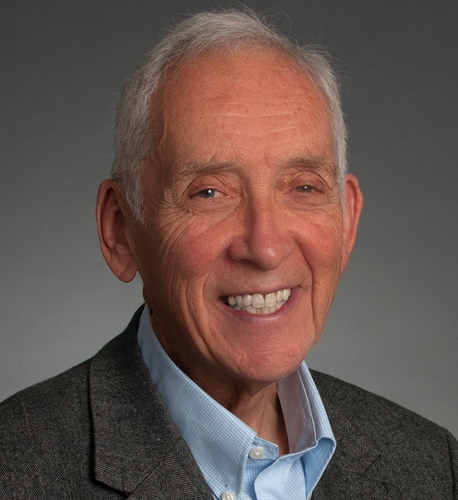
Angelos Findikakis received his first degree in Civil Engineering in 1968 from the National Technical University of Athens, Greece. After working on water resources planning and development studies in Greece he came to Stanford for graduate studies in 1973. Since 1980 he has been working for Bechtel Corporation in San Francisco. Over the years he worked on a broad range of water studies in support of the permitting, design and construction of several industrial projects including civil infrastructure, power, mining, oil and gas, and waste storage facilities. As a Bechtel Fellow since 1998 he advises senior management on questions related to his expertise, participates in strategic planning, and helps disseminate new technical ideas and findings throughout the organization.
Upcoming issues ↑
Issue 4, 2026: Aging Water Infrastructure
Other upcoming issues:
Issue 1, 2027: Artificial Intelligence
Issue 2, 2027: Global Water Security
Issue 3, 2027: Water and Cities
If you wish to contribute to any of the above mentioned issues or propose new topics please contact Editor Angelos Findikakis and our Publications Manager
Previous issues ↑
The online version of Hydrolink is open to non-members as part of IAHR’s efforts to disseminate and share knowledge.
Full access to previous issues Join IAHR!
Advertise with us
Hydrolink currently reaches over 34,000 subscribers targeted as researchers, water engineers, academics, water practitioners, and industry representatives and provides you with the best platform to carry your message to the hydro-environment engineering community. Please check our advertisement rates and offers.
Information for authors
Most articles published in every issue focus on a specific theme developed by the Editor with the support of the Hydrolink Advisory Board and the IAHR Executive Committee. If you would like to propose a theme for a future issue, or contribute an article on one of the planned themes, please contact the Editor Angelos N. Findikakis and the IAHR Publications Manager.
>> Instructions and guidelines for authors [PDF format]
Advisory board ↑
Editor
Angelos N. Findikakis, Bechtel Fellow, Bechtel Corp, USA
Technical Editors
Mehedi Hasan Bappy, Research Engineer, Intelligent Medicine Inc., USA
Mistaya Langridge, McCloy Consulting Ltd, Ireland
Editorial assistant
Martina Marin, IAHR Publications Manager
Advisory board
Luis Balairón, Director of Hydraulics Laboratory, CEDEX - Ministry Public Works, Spain
Jean Paul Chabard, Professor at Ecole des Ponts Paris Tech, Project Manager, EDF Research & Development, France
Jaap C.J. Kwadijk, Scientific director, Deltares, The Netherlands
Henrik Madsen, Head of Research and Development, DHI, Denmark
Sean Mulligan, VorTech Water Solutions and National University of Ireland Galway (NUIG), Ireland
Yasuo Nihei, Tokyo University of Science, Japan
Jing Peng, President, China Institute of Water Resources and Hydropower Research, China
Olivier Bertrand, Project Manager, Artelia Eau & Environnement, France
James Sutherland, Principal Scientist, HR Wallingford, UK
José N. De Piérola, Senior Advisor in Water Resources Management, Peru
Ex-officio
Peter Goodwin, Past President of IAHR, President of University of Maryland Center for Environmental Science, United States of America