Road to Bari
Connecting Water Challenges, Knowledge and Solutions
Towards the 42nd IAHR World Congress
Bari, Italy | 28 June to 2 July 2027
About Communities Journey Congress Timetable Contribute Related
Road to Bari Brochure
Road to Bari Brochure
Road to Bari Brochure
— ABOUT —
What is the Road to Bari?
The Road to Bari is IAHR’s global process leading to the 42nd IAHR World Congress in June 2027. It connects water challenges identified by cities, river basins and public authorities with scientific knowledge, innovation and practical solutions from the international water community.
The process is being built through consultation, peer exchange and progressively wider engagement with cities, utilities, basin authorities, researchers, companies, professional organisations and other actors involved in managing water in practice. Its purpose is to identify shared priorities, connect them with relevant knowledge and experience, and create stronger pathways from ideas to implementation.
In Bari, these communities will come together to exchange what has been learned, showcase relevant knowledge and solutions, and identify priorities and opportunities for continued collaboration beyond the Congress.
Road to Bari is therefore not a single event. It is an ongoing process of engagement and exchange that builds towards Bari 2027 and is intended to create value beyond the Congress itself.
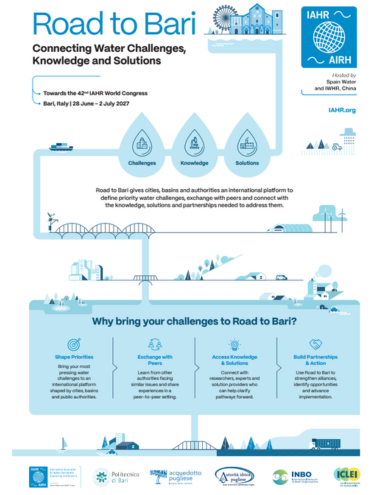
Road to Bari gives cities, basins and authorities an international platform to define priority water challenges, exchange with peers and connect with the knowledge, solutions and partnerships needed to address them.
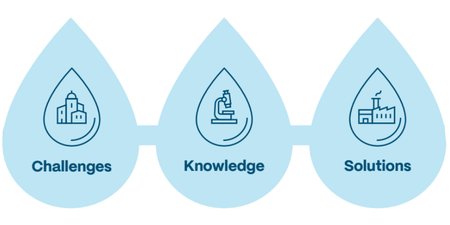
From Challenges to Knowledge and Solutions
Road to Bari connects communities that approach water challenges from different perspectives, creating a pathway between those defining the challenges, those developing knowledge and those contributing solutions and implementation experience.
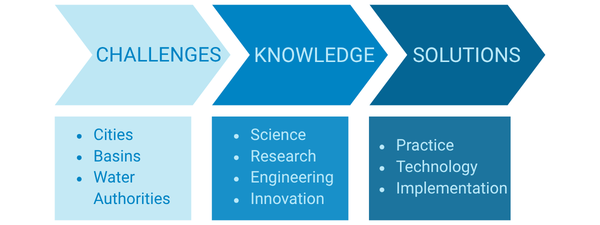
— COMMUNITIES —
Three communities. One shared process
Road to Bari brings together three complementary communities around shared water challenges. Each contributes a different perspective, knowledge base and capacity for action.
1. For Authorities: Technical and Policy Challenges of Cities, Basins and Nations
Road to Bari Brochure
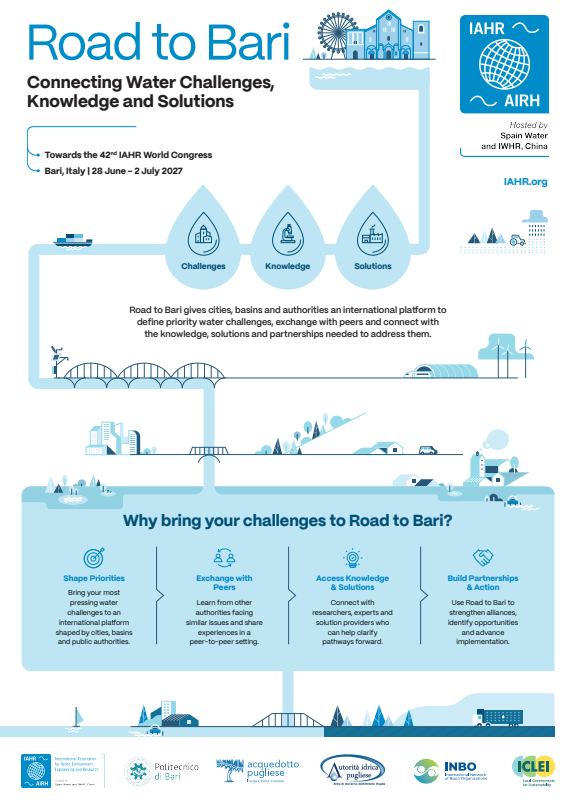
Road to Bari gives cities, basins and authorities an international platform to define priority water challenges, exchange with peers and connect with the knowledge, solutions and partnerships needed to address them.
Shape Priorities — Bring your most pressing water challenges to an international platform shaped by cities, basins and public authorities.
Exchange with Peers — Learn from other authorities facing similar issues and share experiences in a peer-to-peer setting.
Access Knowledge & Solutions — Connect with researchers, experts and solution providers who can help clarify pathways forward.
Build Partnerships & Action — Use Road to Bari to strengthen alliances, identify opportunities and advance implementation.
Download the Road to Bari for Authorities one-pager PDF
2. For Science & Research: Science, Research and Innovation
Road to Bari Brochure
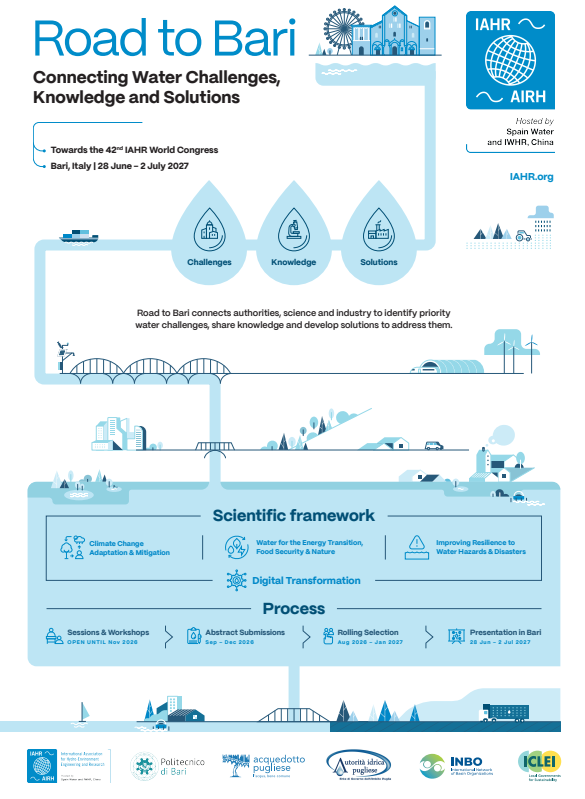
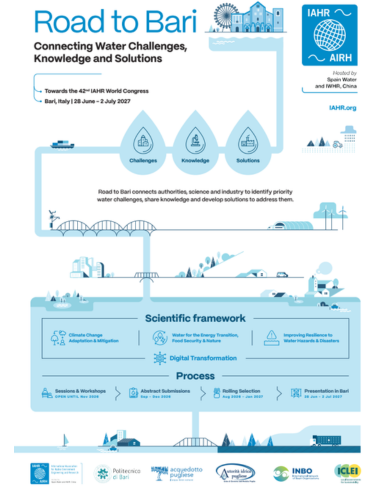
Road to Bari connects authorities, science and industry to identify priority water challenges, share knowledge and develop solutions to address them.
IAHR’s scientific and engineering communities contribute research, evidence, expertise and innovation to the process, helping to connect the priorities identified by authorities and operational actors with relevant scientific knowledge and engineering practice.
Download the Road to Bari for the Science Community one-pager PDF
3. For Industry & Solutions: Solutions, Practice and Implementation
Road to Bari Brochure
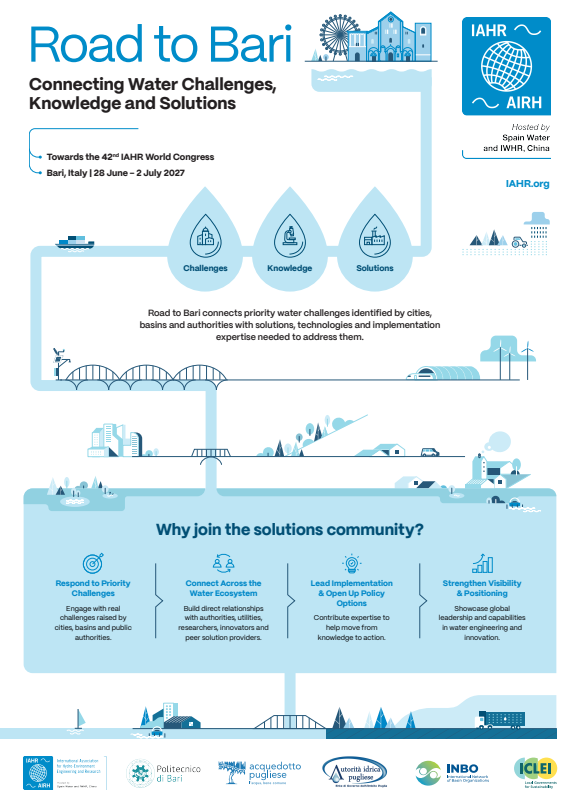
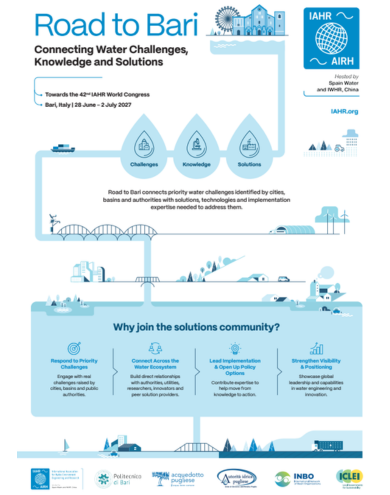
Road to Bari connects priority water challenges identified by cities, basins and authorities with solutions, technologies and implementation expertise needed to address them.
Respond to Priority Challenges — Engage with real challenges raised by cities, basins and public authorities.
Connect Across the Water Ecosystem — Build direct relationships with authorities, utilities, researchers, innovators and peer solution providers.
Lead Implementation & Open Up Policy Options — Contribute expertise to help move from knowledge to action.
Strengthen Visibility & Positioning — Showcase global leadership and capabilities in water engineering and innovation.
Download the Road to Bari for the Industry one-pager PDF
— JOURNEY —
Five Challenge Tables
The Road to Bari consultation process has brought together public authorities, cities, river basin organisations, water utilities, researchers, practitioners and solution providers to identify shared real-world water challenges that require stronger connections between needs, knowledge and implementation.
Through this process, five Challenge Tables have been identified. Each Challenge Table is structured around two guiding questions, creating a total of ten questions that provide a practical framework for the next stage of the Road to Bari dialogue.
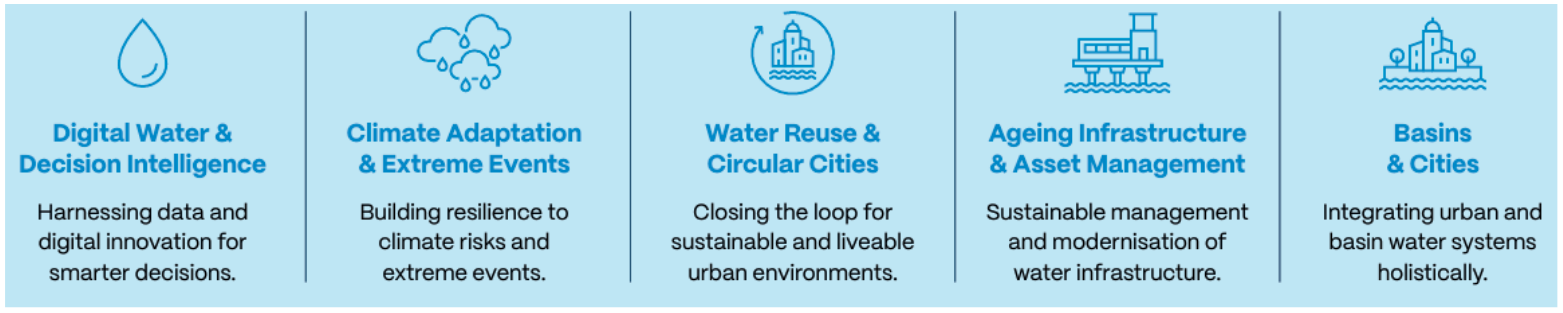
The ten questions are designed to bring together three complementary communities around each challenge: authorities, contributing practical experience, needs and implementation challenges; solution providers, bringing existing and emerging technologies, services and approaches; and the research and scientific community, contributing knowledge, evidence and methods that can inform decision-making and implementation.
The open call around these Challenge Table questions is separate from the scientific call for abstracts. Its purpose is to connect the real-world challenges faced by authorities with relevant knowledge, experience and practical solutions, while creating opportunities for exchange across the three Road to Bari communities.
How science connects to the challenges
The five Challenge Tables describe practical priorities emerging from cities, basin authorities and other operational actors. The scientific contribution is organised differently: through the Road to Bari Scientific Framework, which aligns the scientific programme with IAHR’s strategic thematic priorities.
The Framework provides a broad scientific structure for research, technical committees, working groups and other expert communities to contribute knowledge across the challenges. It is not a second list of Challenge Tables; it is the scientific lens through which IAHR’s research and engineering communities organise their contribution.
Climate Change Adaptation & Mitigation
Water for the Energy Transition, Food Security & Nature
Improving Resilience to Water Hazards & Disasters
Digital Transformation — cross-cutting
The scientific framework is overseen by the International Scientific Committee, while the scientific programme is developed alongside activities that connect all three Action Tracks.
How the Road to Bari works
Road to Bari moves from challenge identification to contribution, selection, preparation and exchange in Bari. The process is designed to widen participation progressively: first identifying priority needs with authorities and operational actors, then connecting those needs with scientific, engineering and implementation communities.
Challenge Definition — Participating cities, basin authorities and other operational actors identify priority water challenges and the practical questions that require wider knowledge, experience or solutions. This stage establishes the five Challenge Tables and the issues that will guide subsequent engagement.
Open Call — IAHR opens the process to the wider community so that researchers, practitioners, companies, professional organisations and other contributors can respond with relevant knowledge, evidence, technologies, approaches and experience.
Responses — Contributions are gathered around the identified challenges. These may include research findings, implementation experience, case studies, technologies, lessons from practice and proposals for discussion in the Congress programme.
Selection & Preparation — Relevant challenges and contributions are refined and connected with the programme for Bari. This stage helps shape sessions, exchanges and other formats in which authorities, scientific communities and solution providers can interact around common issues.
42nd IAHR World Congress — Bari brings the process together. Selected challenges, knowledge, solutions and participants converge through scientific sessions, authority exchanges, innovation activities, panels, workshops, exhibition spaces and other Congress formats.
— CONGRESS —
42nd IAHR World Congress
Drive the Change: Management in the Era of Digital Water & Transitions. Bari, Italy | 28 June–2 July 2027
IAHR World Congresses are held every two years and are among the Association’s principal international meeting points for the hydro-environment community. They bring together scientists, engineers, practitioners, organisations, central and local authorities, companies and young professionals to exchange knowledge, discuss advances and emerging trends, build connections and explore the future of hydro-environment engineering and research.
The 42nd IAHR World Congress in Bari will be the major point of convergence of the Road to Bari. Researchers, engineers, public authorities, water practitioners and solution providers will come together around major water challenges and the Congress theme, Drive the Change: Management in the Era of Digital Water & Transitions.
The Congress will bring together challenges, knowledge, solutions and relationships developed along the Road to Bari and provide a major opportunity to exchange results, experience and priorities for the future.
Learn more about IAHR World Congresses 42nd IAHR World Congresses Official Website
A Message from IAHR President Philippe Gourbesville
IAHR President Philippe Gourbesville invites the international water community to join the journey towards Bari and take part in the 42nd IAHR World Congress.
2026-09-30
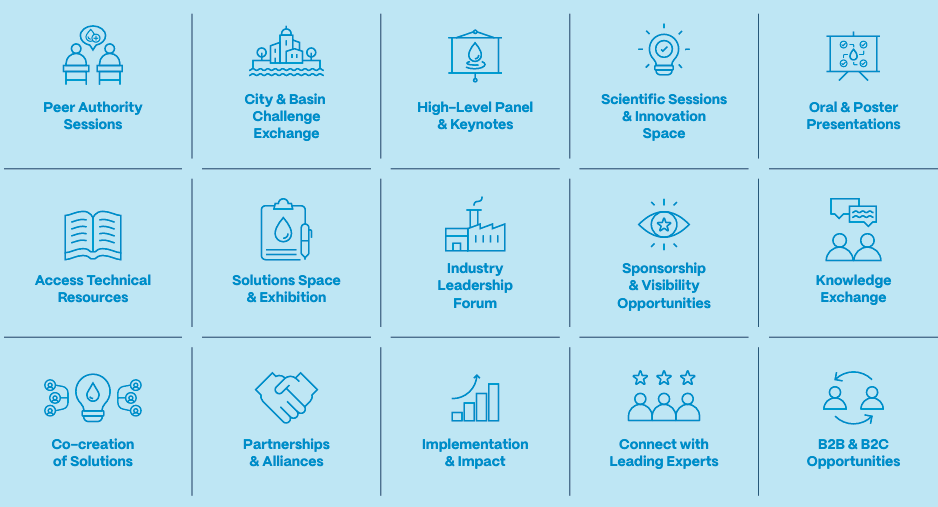
What comes together in Bari
The Road to Bari one-pagers identify the following activities and opportunities for the 42nd IAHR World Congress. All should be represented on this image:
Take Part in Bari 2027
The programme for Bari 2027 is taking shape. Explore current opportunities to contribute to the 42nd IAHR World Congress.
Special Sessions & Workshops
Explore the special sessions and workshops already received and the current opportunities to contribute.
Call for Special Sessions open until 1 November 2026.
Abstract Submissions
Abstract submissions for the 42nd IAHR World Congress are open until 15 January 2027.
2027 John F. Kennedy Student Paper Competition — Students wishing to participate should submit their abstract for the Congress by 15 January 2027.
Explore Special Sessions & Workshops Call for Abstracts
— TIMETABLE —
Milestones
Road to Bari began in 2025 and is being developed through World Congress activity, regional congresses, city and basin engagement, thematic exchanges and programme development. The timeline should show what has already happened, what is happening now and what comes next.
June 2025 — Singapore | Launch of the Road to Bari
The Road to Bari framework was launched during the 41st IAHR World Congress and Singapore Spotlight, establishing the process leading towards Bari 2027.
28 April 2026 — Online | Water & Cities Webinar: Digital Transformation at Canal de Isabel II
An exchange focused on digital transformation and artificial intelligence in a major public water utility.
28 May 2026 — Madrid, Spain | Water & Cities: The Future of Water in Cities — Needs and Challenges
A key preparatory Road to Bari milestone that opened the city-led dialogue and helped identify shared urban water priorities.
9–12 June 2026 — Luleå, Sweden | 9th IAHR Europe Congress
Regional Congress identified in the Road to Bari Framework as part of the sequence of regional milestones towards Bari.
2026 — Incheon, Korea | IAHR Asia-Pacific Congress
Regional Congress identified in the Road to Bari Framework as part of the sequence of regional milestones towards Bari.
16–19 June 2026 — Rio de Janeiro, Brazil | 13th INBO World Water Basin Summit
A Road to Bari milestone focused on engagement with river basin authorities and on connecting basin priorities with scientific knowledge and solutions.
1 October 2026 — Rome, Italy | Euro-Mediterranean Water Forum
Road to Bari advanced the dialogue between cities, basin authorities, utilities and public institutions, including the Basins & Cities Challenge Table.
19–23 October 2026 — Valparaíso and Viña del Mar, Chile | XXXII IAHR Latin American Congress on Hydraulics
Regional Congress identified in the Road to Bari Framework as part of the sequence of regional milestones towards Bari.
8–11 December 2026 — Kigali, Rwanda | 7th IAHR Africa Division Congress
Forthcoming regional milestone in the Road to Bari sequence.
October 2026–January 2027 | Programme Development
Special sessions, workshops, abstract submissions and selection continue to shape the Congress programme and connect contributions with the Road to Bari process.
28 June–2 July 2027 — Bari, Italy | 42nd IAHR World Congress
The principal point of convergence of the Road to Bari.
Beyond Bari
Bari 2027 is a major milestone in the Road to Bari, but the exchange does not need to end with the Congress.
The knowledge, relationships, priorities and opportunities developed through the Road to Bari are intended to support continued dialogue and collaboration beyond the 42nd IAHR World Congress and into the next stages of IAHR’s international congress cycle.
Explore history and future of IAHR World Congresses
— CONTRIBUTE —
Take Part in the Road to Bari
Whether you represent a public authority, the scientific community or the solutions community, Road to Bari provides opportunities to contribute knowledge, challenges, experience and perspectives to the process leading towards Bari 2027.
For Authorities — Bring priority water challenges, exchange with peers and connect with knowledge and solutions.
For Science & Research — Contribute research, engineering expertise, evidence and innovation.
For Industry & Solutions — Respond to priority challenges and contribute technology, experience and implementation expertise.
Contact via email: RoadtoBari27@iahr.org
Organisations involved

Follow us on LinkedIn | Instagram | Facebook | Twitter | WeChat
— RELATED —
Related
Explore the Special Sessions and Workshops Received for the 42nd IAHR World Congress
Call for Special Sessions Now Open for the 42nd IAHR World Congress
Road to Bari Advances in Rome at the Euro-Mediterranean Water Forum
IAHR Advances Road to Bari in Rio and Signs Agreement for Kobe 2029
The Future of Water in Cities: Key Messages and Directions for Action from the Madrid Workshop
Water & Cities Workshop “The Future of Water in Cities: Needs and Challenges”
Water & Cities Webinar Series: Digital Transformation at Canal de Isabel II
On the Road to the 42nd IAHR World Congress in Bari — 28 June to 2 July 2027
