Report from the 41st IAHR World Congress “Innovative Water Engineering for Sustainable Development”
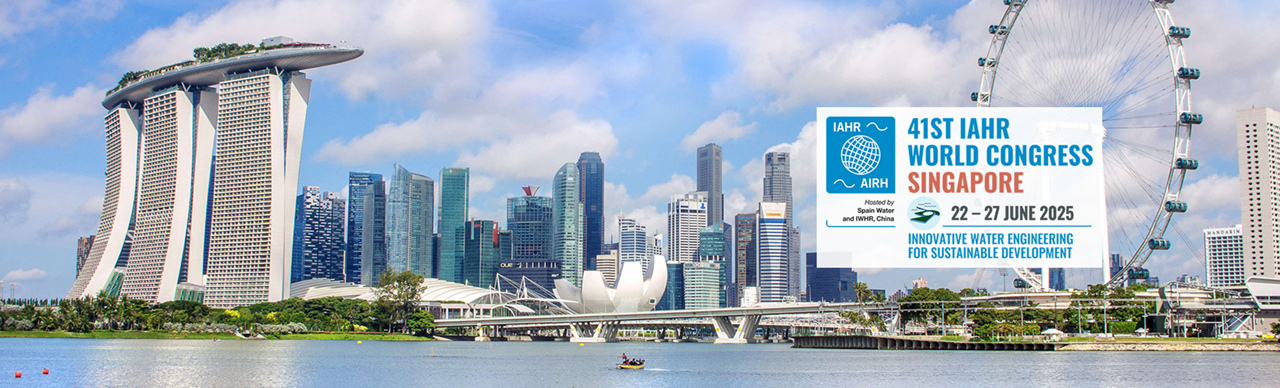
The 41st IAHR World Congress concluded on 27 June 2025, marking a significant milestone for the global hydro-environment community. Held in conjunction with SIWW Spotlight 2025 at the Singapore EXPO, both events brought together more than 2000 delegates with a diverse and dynamic network of researchers, engineers, policymakers, and industry professionals from across the globe.
The 41st edition of the IAHR World Congress was held in Singapore from 22-27 June 2025. The congress was jointly organised by IAHR, PUB Singapore and National University of Singapore. The Congress received strong support from the members of the National Organising Committee, Singapore Tourism Board, and more than 6 sponsors (DHI, Itaipu, Prince Sultan Bin Abdulaziz International Prize for Water, Hydroinformatics Institute, Pluvia and Return), and attracted a total of 1,357 delegates from 61 countries. Participants came predominantly from Asia (65%), followed by Europe (23%), the Americas (7%), Oceania (4%), and Africa (1%). The top three represented countries were China (307), Singapore (172), and the Republic of Korea (129).

Centered on the theme of “Innovative Water Engineering for Sustainable Development”, the Congress featured a comprehensive technical programme covering a diverse range of topics:
Sub-Theme A: Water Engineering and Technological Innovations
A.1 Climate Change Mitigation
A.2 Improving Resilience against Water Hazards and Natural Disasters
A.3 Water Engineering and Society
A.4 Water Engineering for Energy Transition and Food Security
A.5 Digital Transformation
A.6 Experimental and Field Methods
Sub-Theme B: Water Engineering and Socio-Economic Considerations
B.1 Climate Change Adaptation
B.2 Water and Nature
B.3 Hydro-Environment Engineering Culture


The regular technical programme of the Congress received close to 1300 abstract submissions, resulting in 625 oral presentations and 173 poster presentations. It was complemented with additional 49 special sessions, three masterclasses, and four workshops.
The Congress was co-located with Singapore International Water Week (SIWW) Spotlight 2025,
a summit focusing on urban adaptation and resilience to floods and extreme weather events. After the joint opening and presentation of the IAHR Global Water Awards, there were keynote lectures from 3 distinguished speakers: Bernard Koh - Managing Singapore’s Water Resource – Challenges and Innovations Through Time; Ana Deletic - Nature-Based Solutions: Smart Water Management Powered by Nature; and Mark Fletcher - Sustainable Water Management.
The Solutions Marketplace, a combined exhibition for both events, showcasing innovations in water technologies and services, spanned an area of 2,000 sqm and featured 41 exhibitors from 12 countries and regions, including two country pavilions (Singapore and China). The exhibition attracted a total of 1,056 trade visitors, with 20% coming from overseas. Organised by the Singapore Water Association, the Singapore Pavilion was the larger of the two pavilions, occupying 108 sqm and showcasing 12 local exhibitors. It served as a key platform for knowledge exchange and partnerships between academia, industry, and government institutions.
High Level Panels
High-level panel discussions addressed industry case studies and solutions, highlighting how access to knowledge, technology and innovation can drive the transformation of cities towards greater climate resilience.
Water, Cities and Climate: Interconnectedness for a Sustainable Future

Flood-Resilient Cities: How Do We Get There?

Empowering a Just and Inclusive Energy Transition: The Strategic Role of Hydropower
From Digital Acceleration to Real-World Impact: Scaling Innovation in Water Engineering

Young Professionals Programme
A diverse range of activities was organised for Young Professionals during the Congress. The ‘Fireside Chats with Water Professionals’ featured senior leaders from academia, industry, and consultancy, who shared their expertise and experiences, offering participants valuable insights into various career paths. Additionally, the Young Water Professionals (YWP) Symposium and the Young Professionals Network Night created numerous opportunities for attendees to unwind, network with peers, and build new professional relationships in a relaxed and social setting.


Technical Visits
There were technical visits to desalination and water reclamation plants, catchment areas, parks and research centres at the local universities. The different technical visits gave participants a unique opportunity to observe advanced water treatment technologies in operation, gain insight into diverse water management strategies and appreciate Singapore’s commitment to developing a resilient and sustainable water supply system.

IAHR Meetings / Membership Activities
In parallel with the Congress activities, the World Congress serves as the main venue for IAHR membership and governance meetings, including the IAHR Council Meeting and the General Members Assembly.
The Council Meeting was held on 21 June. In addition to addressing regular agenda items, the meeting highlighted the presentation of the “Road to Bari” framework, designed to guide and energise IAHR activities leading up to the next World Congress. This initiative aims to stimulate publications, events, and other activities supported by the Technical Committees, with regional and technical events serving as key milestones along the way.
The General Members Assembly was held on Thursday. Members received the activity and financial reports, and proposed amendments to the Constitution were presented. Both the reports and the amendments were approved. In line with the Association’s statutes, the results of the elections were also announced, with Ioana Popescu elected as the new Vice-President.


Strategic Initiatives
A particularly notable IAHR meeting, extending beyond member activities, was the gathering of the IAHR Global Platform of National Water Associations. The meeting attracted representatives from several national water organisations and featured the presentation of the 2025 IAHR Global Water Innovation Report. This publication marks the first collaborative output of the Platform, an initiative launched by IAHR in 2024 to foster international cooperation, knowledge exchange, and joint action among national water professional associations.
The Platform currently brings together associations from Brazil, Chile, China, India, Indonesia, Mexico, Peru, Portugal, France, Korea, Spain, and Vietnam. Collectively, these countries represent a population of over three billion people, providing a powerful snapshot of both shared and region-specific water challenges and innovation needs.

In addition to the 2025 IAHR Global Water Innovation Report, IAHR also launched the inaugural volume of the IAHR Global Water Institutes Report Series: From Data to Water Decisions: Accelerating the Digital Journey. Although officially presented during the High-Level Panel on Digital Transformation, the report is part of IAHR’s broader efforts to generate global knowledge resources and strengthen collaboration across the water engineering community.

Based on insights from 127 experts across 41 countries, the report identifies five key digital accelerators—Remote Sensing, Data, Sensors and the Internet of Things (IoT), Advanced Modelling, Artificial Intelligence and Machine Learning, and Digital Twins—that are transforming the hydro-environment sector. It provides a strategic roadmap for harnessing digital tools to support smarter and more resilient water management.

The 2025 IAHR Global Water Innovation Report shares the main priorities for water innovation, as identified by national water associations. More than 200,000 water professionals expressed their views through national associations from nine countries. They shared insights on the needs and gaps in water innovation, with numerous professionals identifying similar priorities.
Closing ceremony and dinner
The closing ceremony highlighted the main outcomes of the Congress and offered a glimpse of the upcoming World Congress in Bari in 2027. The evening continued with a dinner that began with a guided tour of the breathtaking Flower Dome, giving participants a moment to reflect on the beauty and fragility of the natural world that unites the IAHR community. The celebration then moved to the main venue, where IAHR President Prof. Philippe Gourbesville welcomed the guests and led a ceremonial cake-cutting to mark IAHR’s 90th anniversary.


IAHR Awards and Distinctions
IAHR Awards and Distinctions
The New IAHR Global Water Awards
On 23 June, during the Joint Opening of the 41st IAHR World Congress, the new Global Water Awards were presented and with that, their three respective laureates. The ceremony was attended by Ms Grace Fu, Minister for Sustainability and the Environment and Minister-in-charge of Trade Relations Singapore, Chen Min, Vice Minister, Ministry of Water Resources of China, Retno Marsudi, United Nations Secretary General Special Envoy on Water, United Nations and Philippe Gourvesbille, IAHR President.

Global challenges are only becoming more urgent on sustainability; climate resilience and mitigation; energy, food and nature; disasters; and digital transformation. By recognising excellence and bringing successes to the attention of the global water community, we can elevate impact and inspire others to continue their important work. Established by the IAHR Council of 2024, there are three new Global Water Awards: Individual category, Organisation category, and Young Professional category.

Prof. Ana Delectic, Adjunct Professor of Civil and Environmental Engineering at University of New South Wales, Sidney, received the 2025 IAHR Global Water Award, Individual category, in recognition of her pioneering contributions to urban water management, sustainable biofilter technology, and advocacy for women in engineering.

Arup received the 2025 IAHR Global Water Award, Organisation category, in recognition of Arup’s pioneering leadership in water resilience, advancing sustainable urban solutions, public health innovations, and fostering global collaboration to address climate challenges.

Dongfeng Li, Assistant Professor at the College of Environmental Sciences and Engineering, in Peking University, received the 2025 IAHR Global Water Award, Young Professional category, in recognition of his groundbreaking research on cryosphere-fed rivers, advancing understanding of climate change impacts on water and sediment fluxes, and his outstanding contributions to hydropower development, water security, and environmental protection.

IAHR Honorary Fellows
The IAHR Honorary Fellows, the most prestigious honour conferred by the IAHR Council, was conferred to three distinguished IAHR members for their life-time contributions to hydro-environment engineering and research and for their outstanding service to the association.

Prof. Vallam Sundar, Advisory Consultant and Professor Emeritus of the Department of Ocean Engineering at the Indian Institute of Technology, Madras, received the 2025 IAHR Honorary Membership Award for his outstanding contributions to coastal, port, and harbour engineering, his leadership in advancing hydro-environment research and education, and his outstanding service to IAHR.

Prof. Jing Peng, President of the China Institute of Water Resources and Hydropower Research and Secretary General of IAHR, received the 2025 IAHR Honorary Membership Award for her exceptional service to IAHR and role model for international collaboration and for women in water-related disciplines.

Federico Estrada, PhD Civil Engineering, Channels and Ports and Director of the Centre for Hydrographic Studies, CEDEX, Spain, received the 2025 IAHR Membership Award for his distinguished service, technical excellence, and unwavering dedication to the IAHR and the global water community.

Arthur Thomas Ippen Award
The Arthur Thomas Ippen Award was established in 1977 to honour the memory of Professor Ippen, IAHR President (1959-1963), IAHR honorary member (1963-1974), and for many decades an inspirational leader in fluids research, hydraulic engineering, and international cooperation and understanding. The Award recognises an IAHR member who has demonstrated conspicuously outstanding ability, originality, and accomplishment in basic hydraulic research and/or applied hydraulic engineering, and who holds great promise for continuation of a high level of productivity in this profession.
The 24th Arthur Thomas Award was conferred to Prof. Bernhard Vowinckel, Professor for Transport Processes in Hydro Systems at the TU Dresden, Germany, in recognition of his pioneering contributions to sediment transport and multiphase flow dynamics, advancing hydraulic engineering through innovative modeling techniques and interdisciplinary research.

M. Selim Yalin Lifetime Achievement Award
Established in 2006 to honour the memory of Professor M. Selim Yalin (1925-2007), Honorary Member and Fluvial Hydraulics Committee Chairperson (1986-1991), remembered for his prolific and pioneering research contributions in fluvial hydraulics and sediment transport, and for his inspirational mentoring of students and young researchers, the M. Selim Yalin Lifetime Achievement Award is conferred upon an IAHR member whose experimental, theoretical, or numerical research has resulted in significant and enduring contributions to the understanding of the physics of phenomena and/or processes in hydraulic science or engineering and who has demonstrated outstanding skills in graduate teaching and supervision.
The 10th M. Selim Yalin Lifetime Achievement Award was conferred to Michele Mossa, Professor of Hydraulics at the Polytechnic University of Bari, and PhD in Hydraulic Engineering for the Environment and Land, in recognition of his groundbreaking contributions to ecohydraulics, particularly in wave-vegetation interactions, and his global leadership in advancing sustainable hydraulic engineering practices through research, education, and interdisciplinary collaboration.

24th Harold Jan Schoemaker Award – For the best paper published in the Journal of Hydraulic Research (JHR)
Conferred ex aquo to;
Saiyu Yuan, from Hohai University, China, for the paper ‘Effects of tributary floodplain on confluence hydrodynamics’, published in the Journal of Hydraulic Research, in August 2023.
Andrea Zampiron, from University of Padova, Italy, for the paper ‘Flow development in rough-bed open channels: mean velocities, turbulence statistics, velocity spectra, and secondary current’, published in the Journal of Hydraulic Research, in February 2023.

9th Willi H. Hager JHR Best Reviewer Award – Acknowledging outstanding peer-review work and commitment to academic excellence.
Conferred to;
Manish Pandey, from the Indian Institute of Technology, Kharagpur, for authoring the most outstanding reviews of the papers submitted to the IAHR Journal of Hydraulic Research during the previous two years.
Maria Rita Maggi, from Roma Tre University, Italy, for authoring the most outstanding reviews of the papers submitted to the IAHR Journal of Hydraulic Research during the previous two years.
Isabella Schalko, from the Swiss Federal Institute of Forest, Switzerland, for authoring the most outstanding reviews of the papers submitted to the IAHR Journal of Hydraulic Research during the previous two years.

16th John F. Kennedy Student Paper Competition – Celebrating innovative research by emerging scholars.
1st prize:
Mohamed Bey Zekkoub, from Électricité de France (EDF), France, for his work on Assessment of Sodium Polyacrylate's Environmental Fate in a River Reach Through-Experiments, Numerical Simulations and Analytical Modeling.
2nd prize:
Tapas Kumar Pradhan, University of Windsor, Canada, for his work on Comparison of Flow Pattern Around Straight and T-Head Spur Dikes.
3rd prize:
Katelyn Kirby, from University of Ottawa, United States of America, for her work on A High-Resolution National Database of River Widths From Remote Sensing and Cloud-Based Image Processing.

Most Active Young Professionals Networks – Recognising vibrant engagement and impact by IAHR’s Young Professional communities.
IAHR Spain Young Professionals Network, from the Europe Division.
IAHR India Young Professionals Network, from the Asia & Pacific Division.
IAHR Venezuela Young Professionals Network, from the Latin American Division.

IAHR Fellows 2025: Honouring distinguished professionals for their long-standing contributions to the field.

Blake P. Tullis, Professor and Interim Associate Vice President of Research at Utah State University, USA
Brett Sanders, Professor at the Department of Civil and Environmental Engineering, University of California, Irvine
Bruce W. Melville, Professor at University of Auckland, New Zealand
Bruno Brunone, Professor of Hydraulics at the University of Perugia, Italy
Claudia Adduce, Professor at Roma Tre University, Italy
Dalila Loudyi, Professor of Water and Environmental Engineering at Hassan II University of Casablanca UH2C-Faculty of Science and Technology, Morocco
Daniele Tonina, Professor at University of Idaho, Centre for Ecohydraulics Research, USA
Donatella Termini, Professor of Hydraulics at Department of Engineering - University of Palermo, Italy
Eric Lesleighter, Hydraulics Engineering Specialist
Fabian A. Bombardelli, Professor at University of California, Davis, USA
Guinevere Nalder, Chartered civil engineer and lecturer/tutor in mathematics and civil engineering, Auckland, New Zealand
Hitoshi Tanaka, Professor at Tohoku University, Japan
Hubert Chanson, Professor in Environmental Fluid Mechanics and Hydraulic Engineering at the University of Queensland, Australia
Jorge Matos, Professor at Instituto Superior Técnico, Universidade de Lisboa, Portugal
Mario J. Franca, Professor of Hydraulic Engineering and Water Resources Management at the Karlsruhe Institute of Technology (KIT), Germany
Orazio Giustolisi, Professor at the Technical University of Bari-Dept. of Civil Engineering and Architecture, Italy
Roberto Gaudio, Professor at Università della Calabria, Italy
Rui M.L. Ferreira, Associate Professor at Instituto Superior Técnico, Universidade de Lisboa, Portugal
Sandra Soares-Frazao, Professor at Universite Catholique de Louvain, Belgium
Stefano Pagliara, Professor at University of Pisa, Italy
Susan Gaskim, Professor in Civil Engineering at McGill University in the Department of Civil Engineering, Canada
Tobias Bleninger, Professor for Environmental Fluid Mechanics and Applied Mathematics, Federal University of Paraná, Brazil
Vijay P. Singh, Professor and Chair at Texas A&M University, USA
Vladimir Nikora, Professor at University of Aberdeen, UK
Weiming Wu, Professor at Clarkson University, USA
Wing Keung, Adrian Law, Professor at School of Civil and Environmental Engineering at the National University of Singapore, Singapore
Yangwen Jia, Chief Engineer at the China Institute of Water Resources and Hydropower Research (IWHR), China
Yujun Yi, Professor at the State Key Laboratory of Regional Environment and Sustainability, Beijing Normal University (BNU), China
Related
Book of Extended Abstracts of the 41st IAHR World Congress (Singapore, 2025)