Summary of the Water and Cities Webinar Series: Digital Transformation at Canal De Isabel II. Madrid Public Water Utility
Water & Cities Webinar Series
Digital Transformation at Canal de Isabel II. Madrid Public Water Utility
Tuesday, 28 April 2026 | 10 - 11 am CEST | 16 - 17 pm CST
ONLINE
Overview
The webinar was organized by IAHR and moderated by IAHR President Philippe Gourbesville. It featured Antonio Lastra from Canal de Isabel II, one of Europe's largest water utilities serving Madrid city and its municipalities.
This webinar is part of a new IAHR series dedicated to Cities & Water issues, with a Workshop planned in Madrid in May 28 and IAHR’s World Congress in Bari, Italy in 2027.
The session revolved around two questions: how is digital transformation affecting Canal de Isabel II and the use of AI, and the implications for the company. Lastly, the session also discussed the benefits of investing in research and development.


1. Digital Transformation at Canal de Isabel II
Antonio Lastra explained that digital transformation has been present at Canal de Isabel II for a long time. Digital transformation goes beyond digitizing paper documents; it's about intelligent use of data throughout the entire water cycle (from abstraction to sewer to wastewater treatment plant). Some of the examples presented were the following:
Digital Twin Examples
Reservoirs and water quality: Canal de Isabel II uses hydrodynamic and biological models to dynamically simulate what happens inside reservoirs, allowing them to anticipate water quality changes weeks in advance.
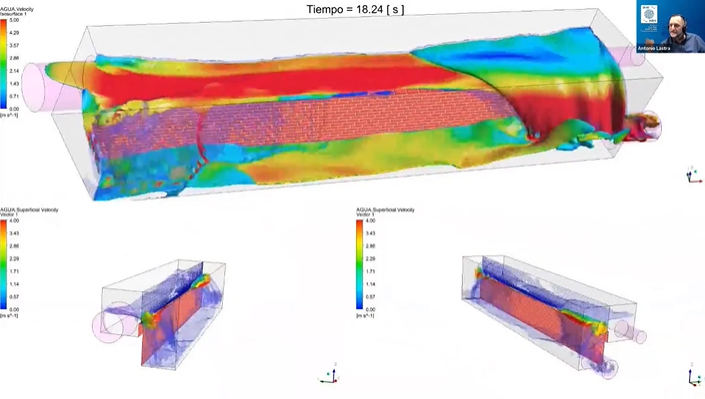
Drinking water tanks: With over 300 tanks where water distribution is not homogeneous, the digital twin visualizes velocities and flows to optimize internal design and improve disinfection.
Wastewater treatment plants: Operating 165 plants where they use digital twins to understand water behavior both in terms of hydrodynamic movement and biological processes.
Sewer networks: Using 3D models with Nabir stock’s equations to understand what happens when water is released to rivers during rainfall, enabling them to identify where to measure pollutant levels.
Real-Time Digital Twins
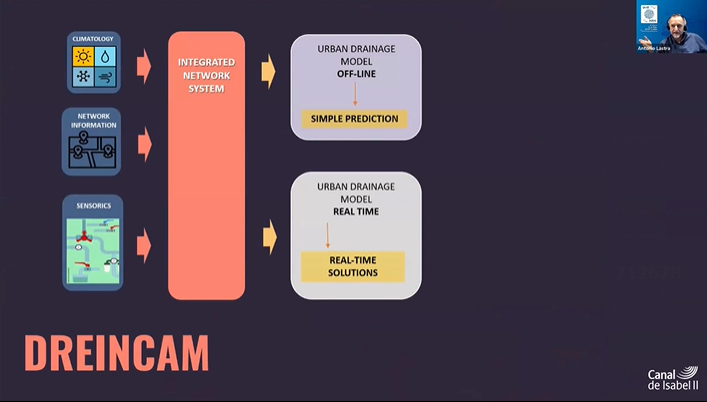
Canal de Isabel II is also building a real-time drinking water network model that automatically updates with consumption and quality data, enabling problem identification and solution optimization. As well as an integrated system for sewers with real-time modeling that uses climatology systems to anticipate rainfall patterns.
2. Artificial Intlligence
In the case of Canal de Isabel II, AI is not a solution for everything, but is a very useful tool in specific cases, such as:
Sediment analysis in reservoirs: Using sonar and AI to extend sediment analysis across entire reservoirs based on point samples.
Design of new infrastructure: Training AI with small models of different configurations to optimize the design of new tanks and treatment plants.
Sewer inspection: AI analyzes camera videos to identify pipe problems, providing consistent results without human fatigue. Data cleaning: Using AI to clean and complete time series from sensors that don't always function perfectly.
3. Research and Development (R&D)
The importance of R&D investment was also emphasized:
Off-the-shelf commercial solutions don't adapt well to their specific needs
They collaborate with Spanish and European universities on projects, doctorates, and laboratories
Key example: They developed an autonomous drone for inspecting large sewer pipes, now commercialized worldwide.
Some of the challenges faced by Madrid’s public utility were the model validation: distinguishing between verification (ensuring the model works in normal operation) and calibration (functioning in new scenarios). Calibration is more difficult, especially in sewer systems where every rainfall is different; and interoperability, which requires good network communication, tools to integrate multiple device types, and crucially, the ability to understand when a device provides faulty data.
Conclusions
Canal de Isabel II's presentation demonstrates a mature and comprehensive approach to water management through digital transformation and artificial intelligence. The company has successfully implemented digital twins across multiple infrastructure points—from reservoirs and treatment plants to sewer networks—enabling real-time monitoring, predictive capabilities, and optimized operations. While AI serves as a valuable complementary tool for specific applications such as image analysis and data cleaning, Lastra emphasizes that traditional hydraulic models remain essential, highlighting the importance of integrating multiple technologies rather than relying on any single solution. Their significant investment in research and development, exemplified by the autonomous drone innovation now commercialized globally, underscores how public sector innovation can create solutions that benefit not only their immediate operations but the entire water industry worldwide.
Related
Discover the The Road to Bari Framework
Water & Cities Workshop "The future of water in cities: needs and challenges" Madrid, Spain, 28 May 2026
IAHR World Congress