The Future of Water in Cities: Key Messages and Directions for Action from the Madrid Workshop
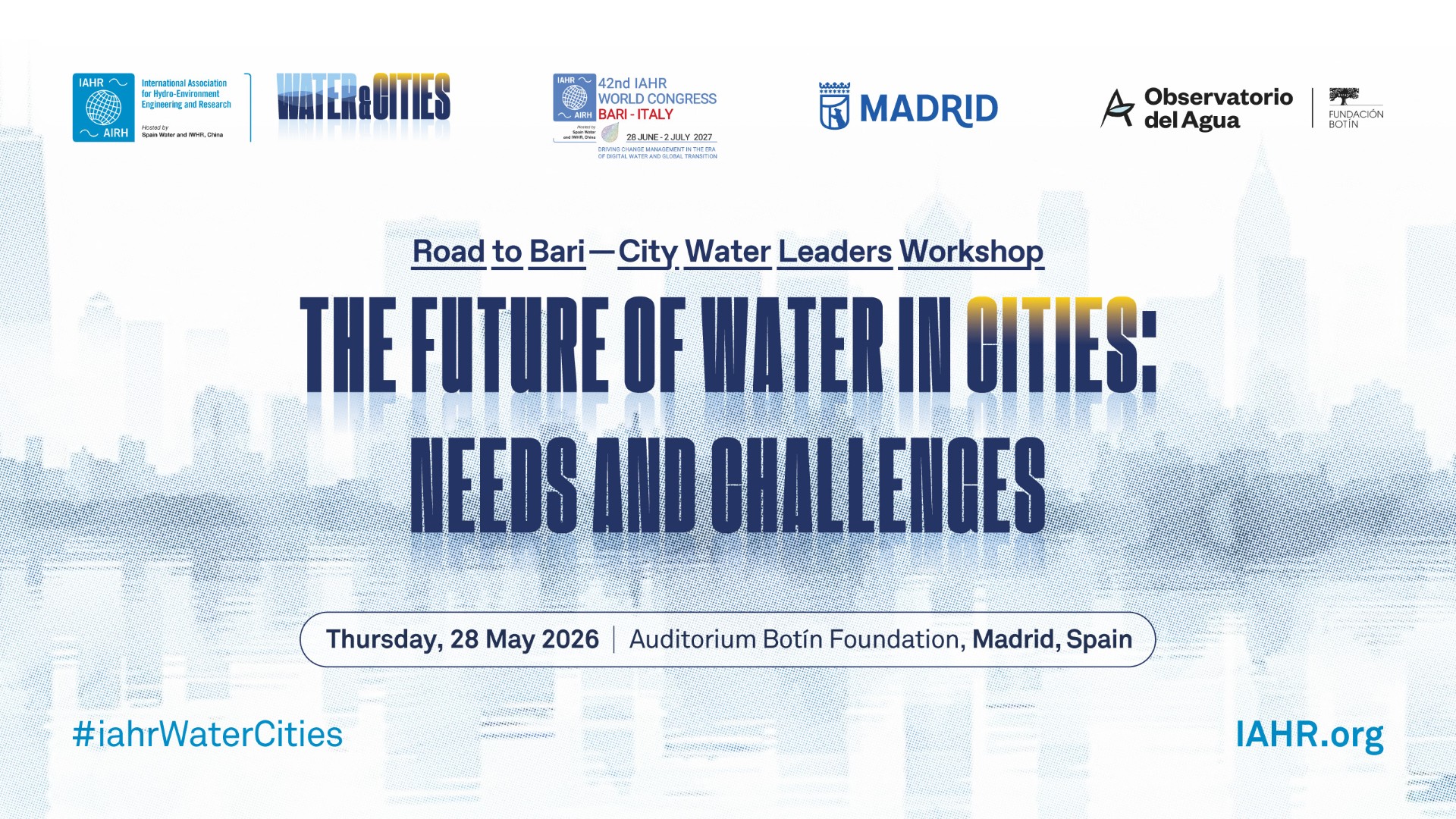
Madrid opened the dialogue - The next step is to broaden it and turn shared priorities into action
Road to Bari Madrid Workshop Summary Website
From Madrid to Bari 2027
On 28 May 2026, city representatives, utilities, researchers, public institutions and private-sector partners met in Madrid to discuss how cities can accelerate the transition towards more resilient, circular and intelligent urban water systems. The workshop marked an important step in the Road to Bari, the process leading to the 42nd IAHR World Congress in 2027.
A clear message emerged: the challenge is not only the availability of technical solutions. Many solutions already exist, including nature-based and sponge-city approaches, water reuse, digital monitoring, early warning systems, water-sensitive planning and improved asset management.
The central task is to create the political, institutional and financial conditions required to implement these solutions effectively and at the city scale. This means sustained political commitment, effective governance, long-term financing, institutional coordination, reliable data, appropriate skills and public awareness.
From Pilot Projects to City-Wide Implementation
Moving beyond isolated projects requires clear implementation pathways: long-term programmes linked to city priorities, defined institutional responsibilities, stable financing, shared data, operational capacity and mechanisms for monitoring results. The workshop therefore focused on how cities can turn proven approaches into coordinated and scalable action, rather than on testing solutions in isolation.
Four Key Messages From Madrid
Water must be a city agenda, not only a utility agenda: Water resilience should be embedded in wider decisions on climate, infrastructure, public space, health and urban development.
Authorities are key to scaling technical solutions: Realising better water outcomes requires technical solutions and knowedge to be supported by effective governance, sustained political commitment and financing, defined responsibilities, long-term planning and adequate institutional capacity.
Cities need practical mesures that can be scaled: The priority is to create pathways from individual projects and pilots to long-term, city-wide programmes supported by clear responsibilities, resources and evidence.
Extreme events need an explicit place on the agenda: Floods, droughts, intense rainfall and water scarcity require preparedness early warning, reliable information, emergency response and stronger coordination before crises occur.
Four Connected Priority Areas
Digital Water & Decision Intelligence - Using data, modelling and monitoring to support better planning, operations and investment decisions.
Climate Adaptation & Extreme Events - Preparing cities for floods, droughts, intense rainfall and climate-driven disruption.
Water Reuse & Circular Cities - Advancing reclaimed water, resource recovery and circular urban water systems.
Ageing Infrastructure & Asset Management - Strengthening the reliability, renewal and resilience of existing water infrastructure.
These areas are closely connected. Progress depends on combining technical solutions with enabling conditions such as appropriate regulation, public trust, crybersecurity, institutional capacity, sustained investment and clear responsibilities across organisations.
Broadening the Dialogue towards Bari 2027
The Madrid workshop was a starting point rather than a conclusion. The next phase of the process will broaden the dialogue by engagin additional cities, utilities, companies, researchers, public authorities and professional organisations. Their participation can help to:
share pratical experience and lessons from implementation;
identify common barries and locally specific needs;
connect scientific and technical expertise with city priorities;
explores collaboration and the wider application of successful approaches;
strengthen a collective agenda towards Bari 2027
Progress should be collective and non-prescriptive. Cities operate in different institutional, climatic and economic contexts; the Road to Bari should therefore encourage peer learning, cooperation and adaptable approaches rather than promote a single model.
Cities can contribute policy and implementation experience; utilities and companies can provide operational knowledge, technologies and delivery capacity; researchers can contribute evidence, analysis and innovation; and public authorities can connect local action with wider regulatory, institutional and financial frameworks.
Towards Bari 2027
The Road to Bari is more than a sequence of meetings. It is a process for building a shared, practical and action-oriented urban water agenda. By connecting cities, researchers, companies, utilities and isntitutions, it can translate existinf knowledge into stronger partnerships, better decisions and scalable action.
The work initiated in Madrid will continue through further engagement and international exchanfe, leading towards the 42nd IAHR World Congress in Bari in 2027. Cities, utilities, researchers, companies, public authorities and professional organisations are invited to contribute to this shared process and help translated common priorities into practical action.
Further information is available at roadtobari.iahr.org