New UNESCO–IAHR Policy Brief on Ecohydrology and Ecohydraulics Unveiled at the 9th IAHR Europe Congress
Overview
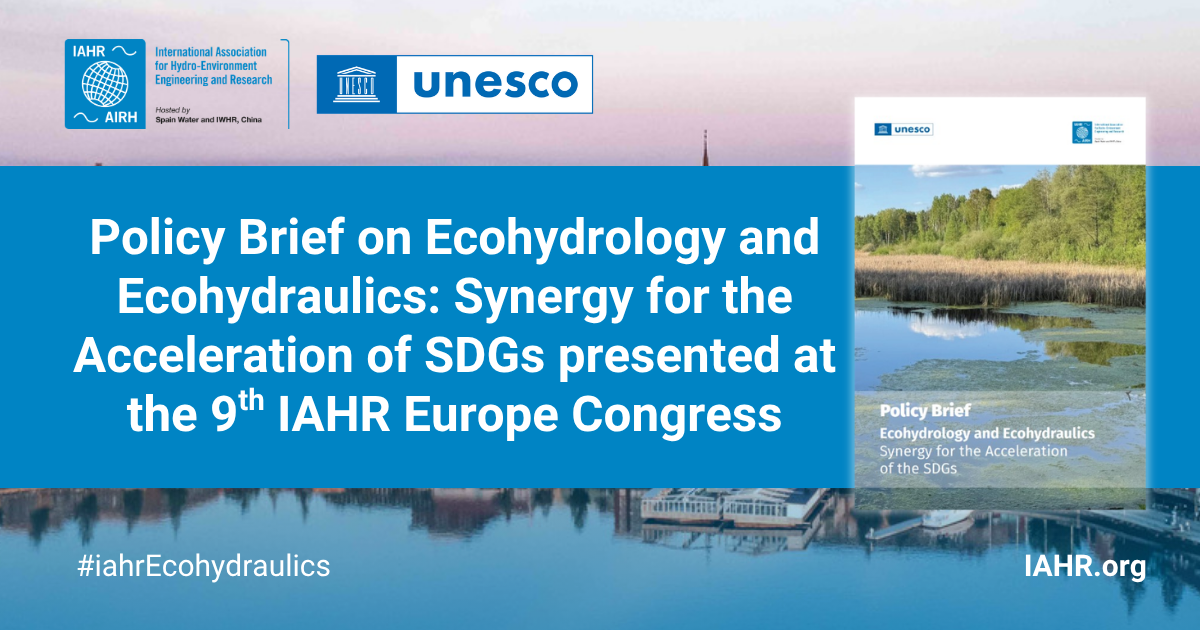
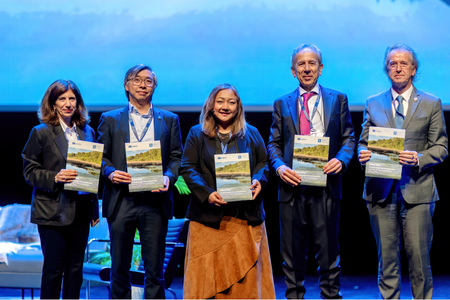 The international Policy Brief “Ecohydrology and Ecohydraulics: Synergy for the Acceleration of the Sustainable Development Goals (SDGs)” was officially presented on 1 June 2026 at UNESCO Headquarters in Paris. The document is the result of a collaborative effort between the UNESCO Ecohydrology Programme and the International Association for Hydro-Environment Engineering and Research (IAHR).
The presentation took place during the Global Celebration of the 30th Anniversary of Ecohydrology at UNESCO and 20 Years of UNESCO Ecohydrology Demonstration Sites, organized within the framework of the 27th Session of the Intergovernmental Council of UNESCO’s Intergovernmental Hydrological Programme (IHP).
The Policy Brief was subsequently presented on 10 June 2026 at the 9th IAHR Europe Congress (Luleå, Sweden), within a dedicated session chaired by Tom Soo. The session included remote presentations by Maciej Zalewski and Peter Goodwin, as well as in-person contributions from Elfithri Rahmah and Michele Mossa.
Published in 2026 by UNESCO and IAHR, the Policy Brief addresses the urgent need to tackle environmental degradation, biodiversity loss, and climate change through a unified approach that integrates Ecohydrology and Ecohydraulics. The Policy Brief reflects IAHR’s commitment to accelerating science-based solutions across the water cycle and strengthening the interface between research, engineering practice and policy-making.
The document was developed by an international team of authors—Giuseppe Arduino (UNESCO Chair at the University of Algarve, Portugal), Rahmah Elfithri (UNESCO-IHP, Paris, France), Angelos Findikakis (Bechtel Corporation, USA), Peter Goodwin (University of Maryland Center for Environmental Science, USA), Michele Mossa (Polytechnic University of Bari, DICATECh, Italy), and Maciej Zalewski (European Regional Centre for Ecohydrology of the Polish Academy of Sciences under the auspices of UNESCO, Poland).


Policy Brief Highlights
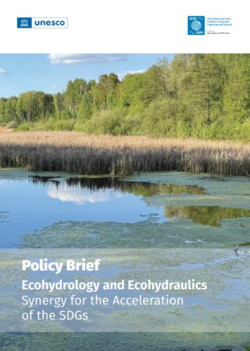 According to the Policy Brief, Ecohydrology and Ecohydraulics provide nature-based and technology-driven solutions that contribute to sustainable water management and enhance the resilience of aquatic ecosystems. Their integration supports innovative approaches to Integrated Water Resources Management (IWRM) and helps strengthen the link between science, policy, and practice.
The document highlights that society is currently facing two major challenges: rapid changes in the water cycle associated with climate change, and the global loss of biodiversity. It emphasizes that stronger integration across scientific disciplines is essential to effectively address these issues.
The Policy Brief also identifies key pressures on aquatic systems, including pollution, nutrient loading, habitat alteration, and increasing anthropogenic impacts. It therefore calls for restoration strategies based on systemic and nature-based approaches rather than isolated interventions.
In this context, the document underscores the importance of Nature-based Solutions (NbS), hybrid green–gray approaches, and Advanced Nature-based Solutions (ANbS) for improving water quality, restoring ecosystem functions, enhancing resilience, and addressing environmental risks.
Ecohydrology is described as focusing on the interactions between ecological and hydrological processes, while Ecohydraulics examines the interactions between hydrodynamic processes and aquatic organisms in rivers, coastal areas, and other water bodies. The integration of these disciplines supports applications such as ecosystem restoration, pollutant transport analysis, biological corridor design, and the management of aquatic environments.
The Policy Brief also highlights the role of innovative technologies—including environmental DNA (eDNA), artificial intelligence, Big Data, drones, and advanced monitoring systems—in improving environmental management and ecosystem monitoring.
The integration of Ecohydrology and Ecohydraulics contributes to sustainable water management and supports the achievement of the Sustainable Development Goals, particularly SDG 6 (Clean Water and Sanitation), SDG 13 (Climate Action), SDG 14 (Life Below Water), and SDG 15 (Life on Land).
The document outlines key recommendations, including the promotion of transdisciplinary approaches, the implementation of Advanced Nature-based Solutions, the transition towards ecosystem-based water governance, the use of innovative technologies, and the engagement of stakeholders and decision-makers through education and policy support.
In this context, Professor Michele Mossa also contributed through his in-person presentation at the 9th IAHR Europe Congress. He underlined the importance of further developing the Policy Brief in the future, including the preparation of dedicated White Papers, and expressed the hope that additional IAHR colleagues will actively contribute to these initiatives.
The Policy Brief is expected to serve as a foundation for future IAHR and UNESCO initiatives aimed at translating scientific knowledge into practical guidance for decision-makers and water professionals worldwide.
Related
IAHR Reports
IAHR Technical Committee on Ecohydraulics
42nd IAHR World Congress, Bari 2027
Water for the Energy Transition, Food Security and Nature