River Flow 2026 Brings the Global Fluvial Hydraulics Community to Thessaloniki
Overview
Overview
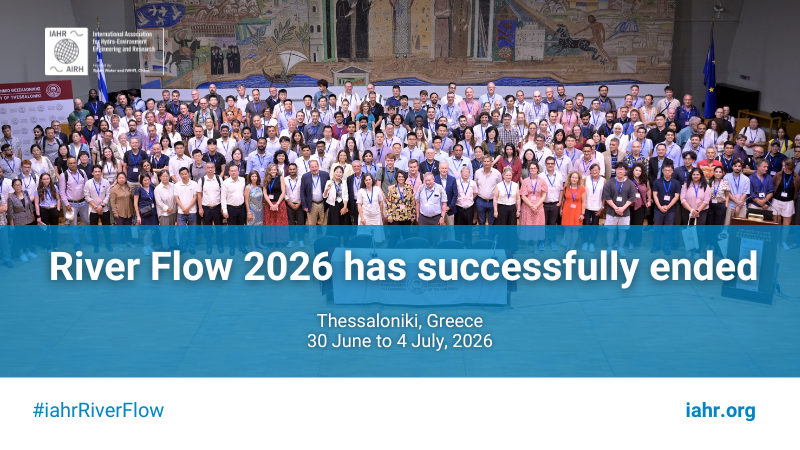
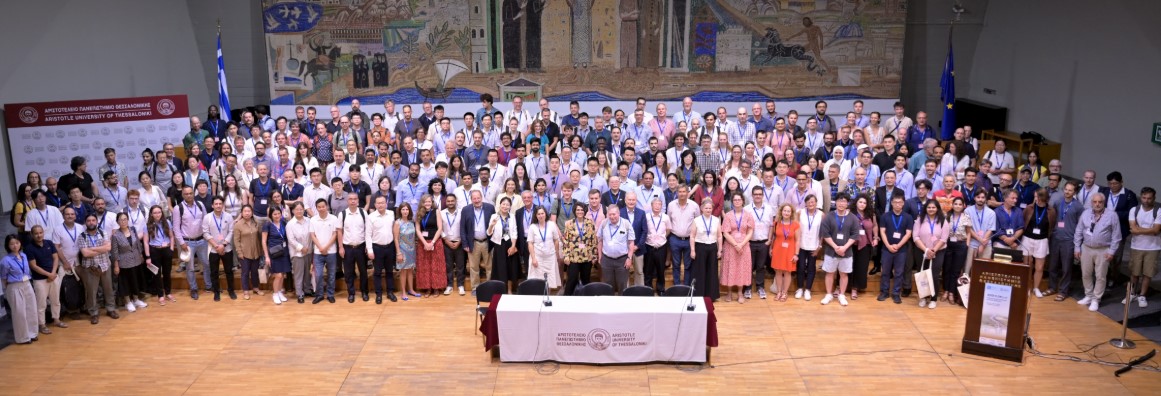
River Flow 2026, the 13th International Conference on Fluvial Hydraulics, brought together the global river engineering community at Aristotle University of Thessaloniki, Greece, from 30 June to 4 July 2026. Held under the central theme, “Steering the Future of Hydro-Environment Research and Practice”, the conference convened researchers, engineers, practitioners, industry representatives and emerging professionals to exchange knowledge and explore practical responses to the changing challenges facing river systems worldwide. Organised under the framework of the IAHR Technical Committee on Fluvial Hydraulics, River Flow 2026 reaffirmed the role of the conference series as a leading international platform for research and practice in fluvial hydraulics, river engineering, sediment transport and river basin management.
Six keynote lectures across three days
Six keynote lectures across three days
The keynote programme brought together six leading researchers working across river systems, sediment transport, hydromorphology, environmental fluid mechanics, flood risk and integrated river management. The keynote speakers were Astrid Blom, Delft University of Technology; Mário J. Franca, Karlsruhe Institute of Technology; Zhiguo He, Zhejiang University; Paola Passalacqua, ETH Zürich; Fotis Sotiropoulos, Penn State University; and Helmut Habersack, University of Natural Resources and Life Sciences, Vienna.
Together, their contributions reflected the breadth of contemporary fluvial hydraulics: from river adjustment under climate change and sediment dynamics to river–floodplain connectivity, resilient infrastructure, advanced modelling and the integration of research into river management practice.
A wide-ranging technical programme
A wide-ranging technical programme
The conference featured more than 50 technical sessions addressing the full spectrum of fluvial hydraulics and river engineering.
The programme covered fundamental flow processes; sediment transport dynamics and river evolution; flow and sediment transport through hydraulic structures; ecohydraulics and river re-naturalisation; pollutant and debris transport; river resilience under climate change; and integrated river basin management.
Across these areas, participants explored the increasing role of advanced monitoring, remote sensing, Earth observation, numerical modelling, machine learning, artificial intelligence and digital tools in understanding river systems and supporting more effective decision-making.
The programme also included the following special sessions:
Bridge Scour and Prevention Measures in the 21st Century
Effects of Vegetation on Flow Dynamics and Sediment Transport
Plastic Pollution in Rivers: Experiments, Numerical Simulation and Field Monitoring
ML/AI Applications in Fluvial Hydraulics and Water Engineering
Earth Observation to Monitor Riverine Ecosystems
Nature-based Solutions for River Systems
Experiment, Simulation, and Risk Analysis of Integrated Hydraulic Desiltation Measures on Long-term River Basin Impact
Expert Panel Session: Water Security under Climate Change
Together, these sessions addressed key emerging challenges for river systems, including bridge safety, vegetation–flow–sediment interactions, plastic pollution, artificial intelligence, Earth observation, nature-based solutions, sediment management and water security under climate change.
Sediment, monitoring and professional development
Sediment, monitoring and professional development
River Flow 2026 was held in conjunction with the 16th International Symposium on River Sedimentation, strengthening the conference’s focus on sediment processes, river morphology and sustainable sediment management.
The programme also included master classes and workshops held on 30 June, the day before the start of the main conference sessions. These activities offered young professionals and early-career researchers opportunities for hands-on learning, discussion and direct exchange with senior experts.
The master classes covered:
Plastic Transport in Rivers
Nature-based Solutions for Flooding and Water Management Resilience in a Changing Climate
Numerical Modelling of Flow, Transport and Flooding in Rivers
Investigating Sediment Fluxes with an Acoustic Doppler Current Profiler (ADCP)
Assessing Turbulent Flows in the Lab Using Laser and Acoustic Methods
Local Scour at Bridge Piers
Sedimentation in Dam Reservoirs: Processes, Impacts and Sustainable Management Strategies
The short courses and workshops addressed:
Advances in Sediment Transport Dynamics
Practical Automation and Post-Processing for Hydraulic Modelling with HEC-RAS
Numerical Modelling of Rivers with Delft3D: From Fundamentals to Applications
WUD – Workshop on Ultrasonic Doppler Measurements for Laboratory Hydraulics and Sediment Transport
Alongside River Flow 2026, the 8th IAHR/WMO/IAHS International Stream Gauging Course was held from 28 to 30 June in Thessaloniki. Organised by the River Flow 2026 Local Organising Committee and the IAHR/WMO/IAHS Working Group on Hydrometry Training Course, the three-day course focused on hydrometric field measurements, hands-on exercises, discharge computation, rating curves, hydrometric data management, uncertainty analysis and data quality control.
Activities for young professionals included a Journal of Hydraulic Research session on scientific publishing and a dedicated Diversity, Equity and Inclusion session, creating spaces for reflection, professional development and exchange across career stages.
Meet the Award Winners of the JRBM Awards and Stephen E. Coleman Award
Meet the Award Winners of the JRBM Awards and Stephen E. Coleman Award
Cesar Augusto Rojas Jimenez
Universidad Distrital Francisco José de Caldas, Colombia
JRBM Best Paper Award 2026

Tonni Agustiono Kurniawan
Xiamen University, China
JRBM Best Reviewer Award 2026

Dresden University of Technology, Germany
Stephen E.Coleman Best Paper Award 2026

During the closing ceremony, IAHR recognised contributions to the International Journal of River Basin Management.
The 2026 JRBM Best Paper Award was presented to César Augusto Rojas Jiménez, Universidad Distrital Francisco José de Caldas, Colombia, for the 2024 paper Integrative framework for analyzing ecosystem services multifunctionality in watershed planning: case study of the Coello River Basin, Colombia.
This paper addresses the challenge of incorporating multiple ecosystem services into watershed planning in a coherent and practical way. Using the Coello River Basin in Colombia as a case study, it examines how different services interact across the landscape and how these patterns can inform planning decisions. The work is valuable because it moves beyond isolated service assessments and supports a more balanced view of environmental management, biodiversity, and human needs.
The 2026 JRBM Best Reviewer Award was presented to Tonni Agustiono Kurniawan, Xiamen University, China, in recognition of his contribution to the journal’s peer-review process.
The closing ceremony also included the Stephen E. Coleman Best Paper Award for Young Researchers, presented by Donatella Termini. The award recognises the best paper submitted to the River Flow Conference Series and authored or co-authored by a young researcher.
The 2026 Stephen E. Coleman Best Paper Award was presented to Ricardo Rebel, lead author of the article First DNS of sediment transport with microscopically realistic sand grains, co-authored by Fröhlich, J.
Congratulations to all!
Institutional outcomes and River Flow 2028
Institutional outcomes and River Flow 2028
River Flow 2026 also marked an institutional step forward for IAHR’s engagement with the Greek water engineering community, with the signing of MOUs with two Greek associations joining the IAHR Global Platform for National Water Associations:
Through the IAHR Global Platform for National Water Associations, national water engineering associations strengthen international cooperation, knowledge exchange and collective action to advance sustainable and resilient solutions to water challenges.
Acknowledgements
Acknowledgements
IAHR extends its thanks to Aristotle University of Thessaloniki, the Local Organising Committee co-chaired by Manousos Valyrakis and Panayotis Prinos, the International Organising Committee, the keynote speakers, session conveners, sponsors, exhibitors and all participants who contributed to River Flow 2026.
IAHR also thanks the event’s sponsors and exhibitors: Ubertone, Sommer, Maccaferri, FLOW-3D HYDRO, NIVUS, CAE, Xylem, Teledyne Marine, Metrica, SEBA and Fathom Scientific.
Through River Flow and its international technical communities, IAHR continues to connect research, innovation and professional practice to advance more resilient, sustainable and better understood river systems.
A full report will be published in the upcoming weeks. The next edition of the River Flow Conference Series was announced during the closing ceremony. River Flow 2028 will take place in Palermo (Italy), from 12 June to 17 June 2028, with Donatella Termini as Chair.
Related
Related
IAHR Technical Committee on Fluvial Hydraulics
River Flow 2026
8th IAHR/WMO/IAHS International Stream Gauging Course
IAHR starts a Global Platform for National Water Associations
IAHR/WMO/IAHS Working Group on Hydrometry Training Course
16th International Symposium on River Sedimentation